
Feb 26, 2008
FOR IMMEDIATE RELEASE
Feb. 26, 2008
Contact: Judith Ingram, Communications Director
(202) 523-3240
WASHINGTON-President Fidel Castro's resignation gives the Cuban government an opportunity to reject its repressive past and chart a future course in which long-trampled freedoms and human rights are protected. Since 2004, the United States Commission on International Religious Freedom has kept Cuba on its Watch List of countries that require close monitoring due to the nature and extent of violations of religious freedom engaged in or tolerated by their governments. Today, the Commission urges the U.S. government to press Cuba through all available diplomatic channels to release all political prisoners, repeal repressive laws, and lift restrictions on freedom of thought, conscience, and religion or belief.
"Cubans have waited too long for the Communist government to recognize their basic human rights, including religious freedom," said Commission Chair Michael Cromartie. "While we have no illusions about Raul Castro's political views, the Commission sees Fidel Castro's resignation as an opportunity for Cuban officials to reform their repressive practices. Cuba's future is best assured by fully protecting, in law and practice, the fundamental freedoms of religion, expression, association and other human rights. The Commission calls on the U.S. government and its allies to send this message clearly to Cuba's new leadership."
The Cuban government abandoned its policy of atheism in the early 1990s; Castro welcomed a visit from Pope John Paul II in 1998, and two years later, religious holidays were reinstated. Those improvements did not last. A wave of arrests of democracy and free-speech advocates began in 2003, and the old tactics of restrictions and surveillance returned. The world saw once again a series of acts that demonstrated the authorities' attempts to impose inappropriate control over religious communities. A 2005 law on religion meant to "legalize" house churches has reinforced the government's efforts to increase control over some religious practice. Political prisoners and human rights and pro-democracy activists are increasingly subject to limitations on their right to practice their religion.
"Fidel Castro's nearly 50-year-long rule was marked by a stormy, and sometimes brutal, relationship with Cuba's religious communities, including arrests, deportations, and severe restrictions on religious activities. Religious life has been unjustly repressed and controlled by his government and generations of Cuban religious adherents have suffered," Cromartie said. "Today the Cuban government has the chance to fulfill its obligation to correct past wrongs and fully protect religious freedom."
The Commission has previously recommended that the U.S. government use all diplomatic means to urge the Cuban government to undertake the following measures:
· revise government Directive 43 and Resolution 46, restricting religious services in homes or other personal property, as well as other national laws and regulations on religious activities, to bring them into conformity with international standards on freedom of religion or belief;
· cease, in accordance with international standards, interference with religious activities and the internal affairs of religious communities, such as denials of visas to religious workers, limitations on freedom of movement of religious workers, infiltration and intimidation of religious communities, arbitrary prevention of religious ceremonies and processions, and attempted interference in the elections in religious bodies;
· order, publicly and officially, the state security agencies to end the instigation of mob violence against religious persons and other human rights activists, including those recently released from prison; the mistreatment of indigenous religious communities; and the harassment of the spouses of imprisoned human rights activists during religious services and hold those involved in any further incidents accountable for their conduct; and
· take immediate steps to end restrictions on religious activities protected by international treaties and covenants, which include the following measures:
– ending the practice of arbitrarily denying registration to religious groups, as well as detaining or harassing members of religious groups and interfering with religious activities because of that unregistered status;
– issuing permits for construction of new places of worship;
– ending the practice of evictions and requisition of personal property of religious individuals or communities without due process, restitution, or provision of alternative accommodation;
– securing the right to conduct religious education and distribute religious materials; and
– lifting restrictions on humanitarian, medical, charitable, or social service work provided by religious communities and protecting persons who conduct such activities in Cuban law.
The U.S. Commission on International Religious Freedom is an independent, bipartisan federal commission that advises the President, Secretary of State, and Congress on how to promote religious freedom and associated rights around the world. It was created by the U.S. Congress in the International Religious Freedom Act of 1998 (IRFA).
Feb 21, 2008
FOR IMMEDIATE RELEASE
Feb. 21, 2008
Contact: Judith Ingram, Communications Director
(202) 523-3240, ext. 127
--Event Advisory--
Public Hearing
Advancing Religious Freedom and Related Human Rights in Iran:
Strategies for an Effective U.S. Policy
Thursday, Feb. 21, 10 a.m. - 12:30 p.m.
Rayburn House Office Building, Room 2359
The U.S. State Department has designated Iran a Country of Particular Concern for its egregious and systematic violations of freedom of thought, conscience, and religion or belief. The situation has deteriorated in particular for religious minorities, including Baha'is, Sufis and Evangelical Christians. Fears of repression have grown in the Jewish community as a result of increased anti-Semitic expression coming from the government and state-controlled media. Dissidents and political reformers continue to be imprisoned on criminal charges of blasphemy and for criticizing the Islamic regime. A number of senior Shi'a religious leaders who have opposed religious and/or political tenets of the Iranian government have also been targets of state repression.
The Commission will hear testimony from an array of distinguished witnesses on human rights abuses in Iran, current U.S. policy, and potential avenues for more effectively addressing rights violations in the Islamic Republic. Confirmed witnesses are:
Panel I:
· Jeffrey Feltman, Principal Deputy Assistant Secretary of State for Near Eastern Affairs
Panel II:
· Barbara Slavin, Senior Fellow, U.S. Institute of Peace & Senior Diplomatic Reporter, USA Today
· Suzanne Maloney, Senior Fellow, Saban Center for Middle East Policy, Brookings Institution
Panel III:
· Payam Akhavan, Co-Founder, Iran Human Rights Documentation Center & Professor of Law, McGill University
· Roya Boroumand, Executive Director, Boroumand Foundation for the Promotion of Human Rights and Democracy in Iran
· Paul Marshall, Senior Fellow, Center for Religious Freedom, Hudson Institute
RSVP: [email protected] or (202)/523-3240, ext. 114
Feb 16, 2008
FOR IMMEDIATE RELEASE
Feb. 15, 2008
Contact: Judith Ingram, Communications Director
(202) 523-3240, ext. 127
WASHINGTON-Anti-Semitism poses a significant danger to the security of countries participating in the Organization for Security and Cooperation in Europe (OSCE), the premier trans-Atlantic group dealing with issues of human rights and democracy, Commissioner Felice D. Gaer told a hearing of the U.S. Commission on Security and Cooperation in Europe (the Helsinki Commission). Intolerance towards one minority community can escalate easily into a more pervasive, general atmosphere of hatred, she said. "We're concerned about physical acts as well as about inaction that fuels an environment of intolerance," she said at the Feb. 7 hearing.
Gaer cited Russia, Belarus, Belgium, and Turkey-and non-OSCE participating states Iran, Uzbekistan and Egypt-as countries witnessing particularly acute surges in anti-Semitic discourse and, in some cases, violence. She urged the Members of Congress attending the hearing, which was chaired by CSCE Chair Rep. Alcee Hastings (D-FL), to resist attempts to trivialize anti-Semitic acts and instead recognize that such acts constitute human rights abuses that can, in some cases, meet the criteria for prosecution as hate crimes.
The OSCE already possesses a unique infrastructure to address anti-Semitism, via three representatives appointed to the organization's Office of Democratic Institutions and Human Rights (ODIHR). "There's no other international agency in the world that deals explicitly and distinctively with anti-Semitism," Gaer noted. However, she emphasized, the representatives' position within ODIHR must be made permanent and full-time. In response to a question by Sen. George Voinovich (R-OH), Gaer also pointed out that staffing and U.S. budget constraints prevent the OSCE from utilizing its human rights resources to the fullest extent possible.
In light of such inefficiencies, the role of the U.S. government in promoting religious freedom and associated human rights in the OSCE region becomes critical, Gaer said. Answering a question from Rep. Chris Smith (R-NJ), she noted that, "We're not using all the tools that we have" to promote tolerance. Even though the United States originally played a substantial role in the creation and maintenance of ODIHR's programs to combat anti-Semitism, as of last year high-level U.S. support began to flag. According to Gaer, ODIHR's "work against intolerance, including anti-Semitism, is no longer singled out for particular mention or support" by the State Department, which wrongly signals that such efforts no longer constitute a top priority for the United States.
Gaer highlighted the Commission's recommendation that the OSCE Chair-in-Office provide more prominence to the three personal representatives through measures including:
·asking them to report in person to the annual full ministerial council meeting;
·ensuring that their reports are published and disseminated throughout and beyond the OSCE system;
·taking them on some of the Chair-in-Office's own visits to neighboring states and participating states; and
·encouraging participating states to invite them to visit the states separately.
"These matters could enhance not only the profile of the personal representatives, but the impact of their findings and recommendations on the scourge of anti-Semitism and combating it directly," Gaer said. Sens. Voinovich and Ben Cardin promised to raise the Commission's recommendation with the OSCE Chair-in-Office this week.
Given the rise in anti-Semitism and other forms of intolerance in the OSCE region, Gaer urged the U.S. government to authorize and appropriate additional funds to ODIHR to expand its programs that would curb expressions of intolerance. Using diplomacy to express the U.S. government's ongoing commitment to the protection of freedom of religion, belief, thought or conscience is equally critical, Gaer said.
The full text of Gaer's oral and written testimonies can be found at www.uscirf.gov .
The U.S. Commission on International Religious Freedom was created by the International Religious Freedom Act of 1998 to monitor the status of freedom of thought, conscience, and religion or belief abroad, as defined in the Universal Declaration of Human Rights and related international instruments, and to give independent policy recommendations to the President, the Secretary of State and the Congress.
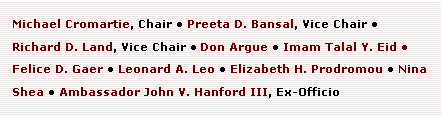
Michael Cromartie, Chair - Preeta D. Bansal, Vice Chair - Richard D. Land, Vice Chair - Don Argue - Imam Talal Y. Eid - Felice D. Gaer - Leonard A. Leo - Elizabeth H. Prodromou - Nina Shea - Ambassador John V. Hanford III, Ex-Officio