
Nov 14, 2017
FOR IMMEDIATE RELEASE
November 14, 2017
State Department Fails to Meet Deadline for CPC Designations
Chairman Mark states that missing the legal deadline tells violators “the United States is looking away”
WASHINGTON, D.C. – The U.S. Commission on International Religious Freedom (USCIRF) criticized the State Department for failing to meet its legal deadline for designating “Countries of Particular Concern” (CPCs). This congressionally mandated list comprises nations that violate religious freedom in a “systematic, ongoing, and egregious” manner. USCIRF’s Chairman Daniel Mark said that “failing to designate CPCs tells the violators of religious freedom around the world that the United States is looking away. The State Department should make such designations without delay.”
The International Religious Freedom Act (IRFA) of 1998 and the Frank R. Wolf International Religious Freedom Act of 2016 mandate that the State Department make such designations no more than 90 days after the State Department releases its annual International Religious Freedom (IRF) Report. That report was released on August 15, 2017.
IRFA also requires that USCIRF provide recommendations, by May 1 each year, to the department on which countries should be designated CPCs for severe religious freedom violations. In April, USCIRF recommended that 16 countries be so designated: Burma, Central African Republic, China, Eritrea, Iran, Nigeria, North Korea, Pakistan, Russia, Saudi Arabia, Sudan, Syria, Tajikistan, Turkmenistan, Uzbekistan, and Vietnam.
Chairman Mark said that “The State Department has not always designated CPCs annually, and the Frank Wolf Act sought to correct that problem. We urge the State Department to rapidly designate the 16 countries recommended by USCIRF. Such an action would be a strong message to religious freedom abusers that the United States is paying attention and takes seriously these violations.”
USCIRF commends Secretary of State Rex Tillerson for the excellent statement he made accompanying the release of the State Department’s International Religious Freedom Report. There, he stated that religious freedom is a “core American value…and universal human right,” commenting further that it is a “human rights priority” for the Trump Administration. USCIRF was highly encouraged by his words and urges the Secretary of State to make CPC designations consistent with that bold and forceful statement.
The Frank Wolf Act also requires the State Department, 90 days after the issuance of the IRF report, to place countries that engage in or tolerate severe violations of religious freedom onto a “Special Watch List.” USCIRF also urges the State Department to speedily announce its Special Watch List, and to include the countries that USCIRF placed on its Tier 2 in 2017: Afghanistan, Azerbaijan, Bahrain, Cuba, Egypt, India, Indonesia, Iraq, Kazakhstan, Laos, Malaysia, and Turkey. USCIRF’s Tier 2 is for countries where USCIRF finds that the government has engaged in or tolerated serious violations that are characterized by at least one element of the “systematic, ongoing, and egregious” standard.
The Frank Wolf Act also requires designations for non-state actors as “entities of particular concern” (EPCs). USCIRF recommended that the Administration designate the following entities as EPCs: the Islamic State of Iraq and Syria (ISIS) in Iraq and Syria; the Taliban in Afghanistan; and al-Shabaab in Somalia. The Administration is not legally required to make its EPC designations at this time, but USCIRF looks forward to working with the White House and the State Department on expeditiously identifying EPCs and the tools to use against them.
Read USCIRF’s 2017 Annual Report here.
###
The U.S. Commission on International Religious Freedom is an independent, bipartisan U.S. federal government commission, the first of its kind in the world. USCIRF reviews the facts and circumstances of religious freedom violations abroad and makes policy recommendations to the President, the Secretary of State, and Congress. USCIRF Commissioners are appointed by the President and the Congressional leadership of both political parties. To interview a Commissioner, please contact USCIRF at [email protected] or John D. Lawrence, Director of Communications ([email protected]/ +1-202-786-0611).
Nov 1, 2017
FOR IMMEDIATE RELEASE
November 1, 2017
IRAN: Fariba Kamalabadi, Religious Prisoner of Conscience, Released
Vice Chairwoman Arriaga praises Ms. Kamalabadi’s “courage, grounded in the faith that the Iranian government has tried so hard to repress”
WASHINGTON, D.C. – The U.S. Commission on International Religious Freedom (USCIRF) welcomes the release of Iranian religious prisoner of conscience Fariba Kamalabadi, one of the Baha’i leaders known as the “Yaran” (Friends in Iran). In 2008, all seven leaders were arrested and sentenced to prison, charged with espionage and “spreading propaganda against the regime.” Ms. Kamalabadi was released after serving her full 10-year sentence. This followed the September 2017 release of Mahvash Sabet, a fellow Yaran who also was held in Tehran’s Evin Prison. The other five Yaran remain imprisoned.
“Fariba is a mother, a psychologist, a teacher, and ultimately an Iranian citizen who has been denied her rights in a blatant violation of her religious freedom. Fellow prisoners described her compassion and courage, grounded in the faith that the Iranian government has tried so hard to repress,” said USCIRF Vice Chairwoman Kristina Arriaga, who has advocated in support of both Ms. Sabet and Ms. Kamalabadi. “We welcome her release but remain steadfast in calling for the release of the other Yaran and all Iranian religious prisoners of conscience.”
Vice Chairwoman Arriaga took up Ms. Kamalabadi’s and Ms. Sabet’s cases as part of USCIRF’s Religious Prisoners of Conscience Project. Through this project, Commissioners work for the release of individuals who have been imprisoned for their religious identity, beliefs, practices, or advocacy and highlight the laws and policies that led to the imprisonment.
Since 1999, USCIRF has recommended, and the State Department has designated, Iran as a “country of particular concern” (CPC) for the government’s systematic, ongoing, and egregious religious freedom violations. Since President Hassan Rouhani’s election in 2013 and reelection in May 2017, the number of individuals from religious minority communities who are in prison because of their beliefs has increased. These prisoners demonstrate the Iranian government’s callous disregard for the international human rights agreements that Iran has ratified.
USCIRF Chairman Daniel Mark stated, “This month, the State Department should release its designations of CPCs. USCIRF continues to recommend that the State Department designate Iran as a CPC based on systematic, ongoing and egregious violations of religious freedom targeting not only Baha’is but also Christian converts, Sunni and Sufi Muslims, and dissenting Shi’a Muslims. The U.S. government must stand firm for the religious freedom of the Iranian people utilizing all policy tools available, including asset freezes and visa bans targeting those accountable for violations."
Read USCIRF’s 2017 Annual Report Iran chapter here (Persian translation).
###
The U.S. Commission on International Religious Freedom is an independent, bipartisan U.S. federal government commission, the first of its kind in the world. USCIRF reviews the facts and circumstances of religious freedom violations abroad and makes policy recommendations to the President, the Secretary of State, and Congress. USCIRF Commissioners are appointed by the President and the Congressional leadership of both political parties. To interview a Commissioner, please contact USCIRF at [email protected] or John D. Lawrence, Director of Communications ([email protected]/ +1-202-786-0611).
Nov 1, 2017
The following op-ed appeared in The Diplomat on November 1, 2017
By former Commissioners Sandra Jolley and Tenzin Dorjee
As U.S. President Donald Trump prepares to travel to China in early November he should include in his daily tweets the hashtags of #FreeReligiousPrisoners and #ReligiousFreedom. Out of nearly 1.4 billion citizens of China, untold numbers are victims of the Chinese government’s relentless drive for control over religious beliefs, activities, and advocacy.
In mid-October, China’s 19th Party Congress met and confirmed President Xi Jinping’s dominance and increased control over all aspects of Chinese life. As expected as it was, this bodes very badly for the millions in China seeking greater freedom of religion or belief.
As part of its brutal campaign, China seeks to erase the Tibetan and Uyghur cultures and their respective religions through “sinicization” — the government’s bid to conform religion to its own image. Seeking stability and control, its repressive actions have caused suffering and despair among Tibetan Buddhists and Uyghur Muslims, as well as other religious and ethnic communities.
We want to highlight two of China’s many religious prisoners.
One is a Tibetan Buddhist destined to be his people’s leader. The other is a 39-year-old Uyghur Muslim, community leader, website administrator, and government worker.
Both are prisoners of conscience, unfairly treated by the Chinese government, and on whose behalf we are working as part of the Religious Prisoners of Conscience Project of the U.S. Commission on International Religious Freedom (USCIRF), on which we serve.
The Tibetan Buddhist is Gedhun Choekyi Nyima, whom His Holiness the Dalai Lama chose as the 11th Panchen Lama, the second highest position in Tibetan Buddhism. Three days after his selection in 1995, Chinese government authorities kidnapped the then six-year old and his family from their home in Tibet. The government has kept him “disappeared” for more than two decades, making him one of the world’s longest-held prisoners of conscience.
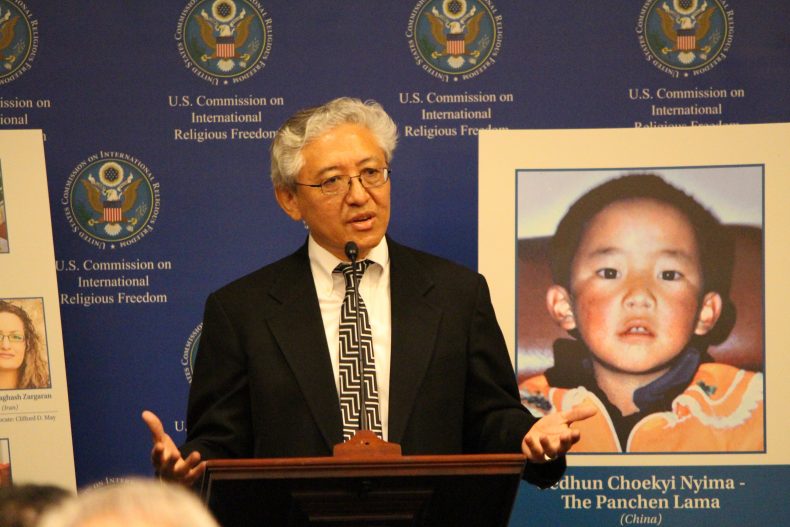
USCIRF Commissioner Tenzin Dorjee, the first Tibetan Buddhist appointed to the Commission, calls on China to release the Panchen Lama at a rollout of USCIRF’s Religious Prisoners of Conscience Project (Photo Credit: USICRF).
The Uyghur Muslim is Gulmira Imin, who was born and raised in the Xinjiang Uyghur Autonomous Region of northwest China. Imin was the moderator of Salkin, a now defunct Uyghur-language culture and news website, to which she contributed poetry and short stories that included criticism of Chinese government policies. In July 2009, authorities accused her of organizing protests which, initially peaceful, turned violent.
On April 1, 2010, the Urumqi Intermediate People’s Court sentenced her to life in prison on charges of “splittism, leaking state secrets, and organizing an illegal demonstration.” Gulmira says that she was tortured, forced to sign documents she had not read, and denied access to a lawyer until her trial. Gulmira’s only “crime” was her leadership in the Uyghur community and participation in the protests.
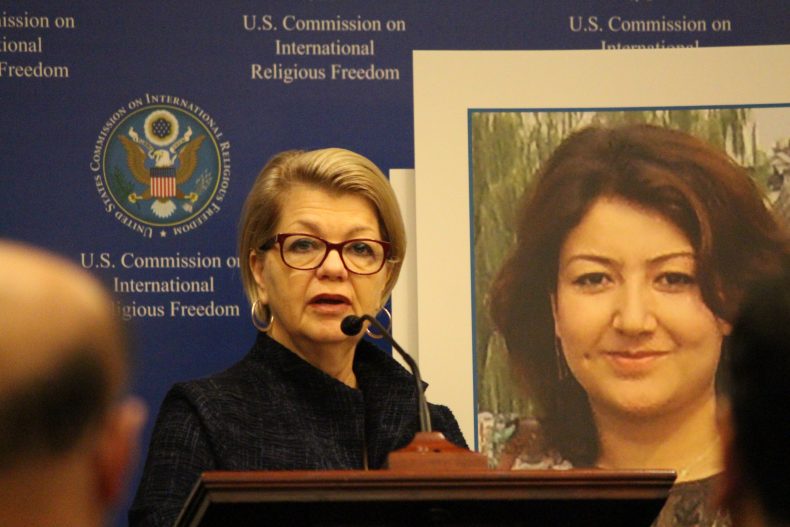
USCIRF Vice Chairwoman Sandra Jolley, speaks out on behalf of Gulmira Imin at a rollout of USCIRF’s Religious Prisoners of Conscience Project (Photo Credit: USICRF).
In both the Tibetan Autonomous Region (and Tibetan areas of other provinces) and Xinjiang, the government dramatically has increased the security apparatus through extensive surveillance and placed government officials in houses of worship and private homes to verify that no “illegal” religious activity occurs. Authorities monitor phones and computers, install closed-circuit television, restrict travel within and outside of the regions, cancel previously permitted festivals, and have imprisoned thousands.
Seeking to reduce the influence of religion in both areas, the government has used the excuse of public safety to destroy thousands of mosques in Xinjiang and religious buildings in Tibet and Tibetan areas of China, including the Larung Gar Buddhist Institute.
The Chinese government also has targeted children, believing that they will be easier to “sinicize” if they are ignorant of their religion and culture. Authorities in Tibet prohibit children from learning the Tibetan language and participating in religious holidays, threatening them with expulsion from school if they fail to comply. Similarly, as of November 1, 2016, Uyghur Muslim parents are forbidden from including their children in any religious activity.
These and other measures exemplify the actions Party Secretary Chen Quanguo has taken to ensure the government’s control over religious and ethnic minorities. From 2011-2016, Chen led efforts in Tibet to install a sophisticated surveillance network and undertook other repressive measures. He has been replicating these actions in Xinjiang since his reassignment there in August 2016.
Because of these and other abuses, USCIRF has recommended since 1999 that the State Department designate China as a “country of particular concern” (CPC) for its systematic, ongoing, and egregious violations of religious freedom. The State Department has designated China as a CPC since 1999, most recently in October 2016. USCIRF encourages the State Department to again designate China when it makes this year’s designations, which are due in mid-November.
USCIRF also urges the swift enactment of H.R. 1872, the Reciprocal Access to Tibet Act, which would send an important signal to China about the need for mutual access and reciprocity. We also urge the administration to deny visas to, and freeze assets of, Chinese officials subject to provisions in the Global Magnitsky Human Rights Accountability Act and the Frank R. Wolf International Religious Freedom Act.
With President Trump going to China, we must not forget the persecution and struggles of Tibetan Buddhists, Uyghur Muslims, and the many other members of religious and ethnic minority communities. The Chinese government must uphold, not repress, their rich religious and cultural traditions and free the many prisoners of conscience, including the Panchen Lama and Gulmira Imin.
Sandra Jolley is Vice Chairwoman and Commissioner and Tenzin Dorjee is Commissioner on the U.S. Commission on International Religious Freedom, an independent, bipartisan federal commission created by Congress to monitor and review violations of religious freedom abroad and make policy recommendations to the President, the Secretary of State, and the Congress. They have adopted the prisoners in the Op-Ed as part of USCIRF’s Religious Prisoners of Conscience project and have been advocating for their freedom.