Aug 12, 2016
FOR IMMEDIATE RELEASE
August 12, 2016
WASHINGTON, D.C. – Religious freedom is under attack today in many nations around the world, harming individuals and threatening the stability of societies worldwide. The U.S. Commission on International Religious Freedom (USCIRF) welcomes the attention given to this vital right in the U.S. State Department’s latest International Religious Freedom (IRF) Report, released on August 10. Covering 2015, the report comprehensively documents religious freedom violations in almost 200 countries, features the cases of thousands imprisoned because of their religion or belief, and highlights non-state actors’ egregious abuses. USCIRF is pleased to see that this year’s report gives additional attention to the pernicious consequences of blasphemy laws.
“About 74% of the world’s population are living in countries with serious restrictions on religious freedom, according to David Saperstein, the Ambassador-at-Large for Religious Freedom. This large number reinforces the importance of religious freedom and the task we have before us,” said USCIRF Chair Thomas Reese, S.J. “We at USCIRF applaud the State Department for the excellent work that went into this report and its efforts to encourage countries around the world to adopt policies that respect this fundamental right. The U.S. government can help ensure positive change. Let’s not miss this opportunity to strengthen our commitments with effective actions.”
The International Religious Freedom Act of 1998 (IRFA) requires the State Department annually to issue an IRF Report and, based on that report, designate as “countries of particular concern” (CPCs) those governments that “engage in or tolerate” systematic, ongoing, and egregious violations of religious freedom and take action to encourage improvements in those countries. Earlier this year, the Department designated 10 nations as CPCs under IRFA: Burma, China, Eritrea, Iran, North Korea, Saudi Arabia, Sudan, Tajikistan, Turkmenistan, and Uzbekistan. USCIRF agrees with these designations, and recommends that the State Department:
- Designate as CPCs seven additional countries – Central African Republic, Egypt, Iraq, Nigeria, Pakistan, Syria, and Vietnam: Pakistan’s government, for example, clearly meets IRFA’s CPC standard, but has never been so designated. Religiously-discriminatory constitutional provisions and laws, such as the country’s blasphemy and anti-Ahmadiyya laws, result in prosecutions and imprisonments. Religious minority communities, including Shi’a and Ahmadiyya Muslims, Christians, and Hindus, experience chronic sectarian and religiously-motivated violence from both terrorist organizations and individuals. The government’s failure to adequately protect targets of such violence or prosecute perpetrators has created a deep-rooted climate of impunity.
- Follow up CPC designations with concrete actions. The State Department designated Tajikistan as a CPC for the first time in 2016, but issued a waiver on taking any action as a consequence of the designation. Waivers also are in place for Saudi Arabia, Turkmenistan, and Uzbekistan. While permitted under IRFA, waivers leave little incentive for CPC-designated countries to make improvements; therefore, USCIRF has recommended that they should be limited to a set period of time and subject to review for renewal.
- While permitted under IRFA, because waivers provide little incentive for CPC-designated countries to make improvements, USCIRF has recommended that they should be limited to a set period of time and subject to review for renewal.
- Use all of IRFA’s tools: IRFA provides the Secretary of State with various options to promote religious freedom, including negotiating a binding agreement, a rarely-used tool. USCIRF has recommended that the United States seek to negotiate binding agreements with, for example, the governments of Burma and Vietnam – both countries with which U.S. relations are expanding. Burma has been designated as a CPC since 1999. After more than 50 years of a military-controlled government, the new Burmese government will have many priorities; it is essential for the U.S. consistently to reinforce the importance of religious freedom and human rights for all its citizens, including Rohingya Muslims and Christians. As for Vietnam, USCIRF urges the United States to designate it as a CPC, and actively take steps to support meaningful and lasting reforms, including with respect to the proposed religion law. A binding agreement would build on the two countries’ proven working relationship and an earlier binding agreement when Vietnam was designated as a CPC from 2004-06.
USCIRF also welcomes the increased attention this year’s IRF Report gives to violations non-state actors have committed, which pose some of the greatest threats to religious freedom in today’s world. Now Congress needs to do its part by expanding the CPC classification to allow for the naming of non-state actors perpetrating systematic, egregious, and ongoing violations.
For more information, including on countries noted here and other countries USCIRF has recommended to be designated as CPCs and Tier II nations, please see USCIRF’s 2016 Annual Report.
To interview a Commissioner, please contact USCIRF at [email protected] or 202-786-0615
Aug 4, 2016
FOR IMMEDIATE RELEASE
August 4, 2016
WASHINGTON, DC– Senate Majority Leader Mitch McConnell (R-KY) on August 2, 2016 appointed Clifford D. May to the U.S. Commission on International Religious Freedom (USCIRF).
“USCIRF welcomes Cliff May as a strong addition to our Commission and its mission,” said USCIRF Chair, Thomas J. Reese, S.J. “Given his remarkable depth of knowledge and experience and passionate advocacy for freedom, he will be a great asset to USCIRF and our mandate, helping advance the pivotal right of religious freedom around the world and its integration into our country’s foreign policy.”
Clifford D. May is the founder and President of the Foundation for Defense of Democracies. Mr. May has had a long and distinguished career in international relations, journalism, communications and politics. A veteran news reporter, foreign correspondent and editor (at The New York Times and other publications), he has covered stories in more than two dozen countries. A former syndicated columnist for Scripps Howard News Service, he is currently the weekly “Foreign Desk” columnist for The Washington Times. His writing also has appeared in The Wall Street Journal, Commentary, National Review, USA Today, The Atlantic and many other publications. He is the co-editor of a book on the conflict in Afghanistan and Pakistan, as well as one on energy policy. He was appointed as an advisor to the Iraq Study Group (Baker-Hamilton Commission) of the United States Institute of Peace in 2006, and served on the bipartisan Advisory Committee on Democracy Promotion from 2007 to 2009. From 1997 to 2001, he served as the Director of Communications for the Republican National Committee. Mr. May holds master’s degrees from both Columbia University’s School of International Affairs and its School of Journalism. His undergraduate degree is from Sarah Lawrence College, and he holds a certificate in Russian language and literature from Leningrad State University, USSR. He is a member of the Washington Institute of Foreign Affairs.
Comprised of nine commissioners, USCIRF is an independent, bipartisan federal body that is principally responsible for reviewing the facts and circumstances of violations of religious freedom internationally and making policy recommendations to the President, Secretary of State, and Congress. The President and leadership of both political parties in the Senate and House of Representatives appoint USCIRF Commissioners.
To interview a Commissioner, please contact USCIRF at [email protected] or 202-786-0615.
Aug 2, 2016
View this press release in Spanish
FOR IMMEDIATE RELEASE
August 2, 2016
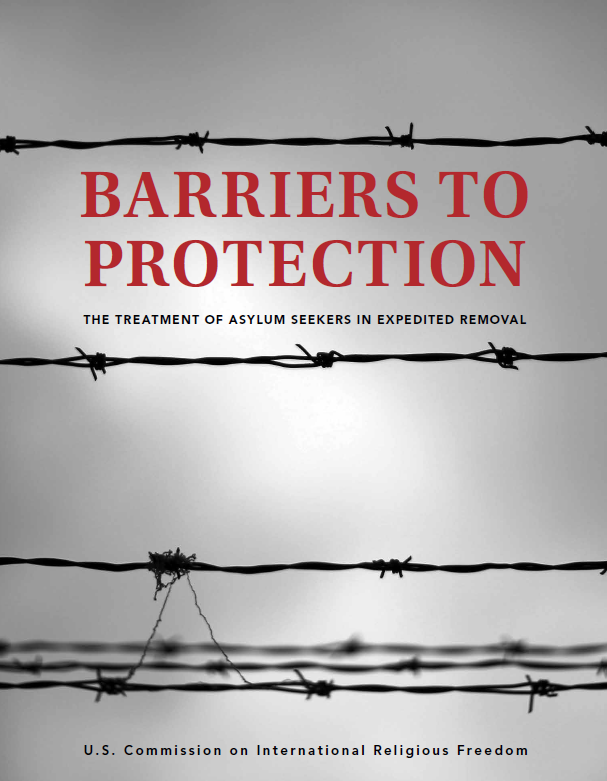 WASHINGTON, D.C. – More than ten years after highlighting serious problems with the U.S. government’s treatment of asylum seekers in Expedited Removal, the U.S. Commission on International Religious Freedom (USCIRF) has found continuing and new concerns. In its newly released report, Barriers to Protection: The Treatment of Asylum Seekers in Expedited Removal, USCIRF documents major problems in processing and detention that start the moment asylum seekers enter the United States.
“How we treat people who come to our borders says a lot about who we are as Americans. Those seeking refuge from persecution deserve to be treated with dignity and should not be confined in prison-like conditions simply for seeking freedom and protection in the United States. It is a travesty that in the ten-plus years since USCIRF first documented serious failures in the Expedited Removal process, the United States has failed to address these issues, with dramatic consequences for men, women, and children,” said USCIRF Chair Thomas J. Reese, S.J.
Expedited Removal is a program through which the U.S. Department of Homeland Security (DHS) can summarily return to their countries of origin certain non-citizens who arrive at U.S. ports of entry or cross the border. Barriers to Protection draws attention to the negative impact, especially on children, of the U.S. Immigration and Customs Enforcement (ICE)’s detention of asylum seekers in institutional settings. Service providers recounted that children in detention experienced depression, post-traumatic stress disorder, developmental regressions, anxiety, and social withdrawal. Several courts have found that these facilities do not comply with the U.S. government’s own standards for child detention as determined in a 1997 legal settlement, the Flores Agreement.
The report highlights examples of DHS officials’ flawed processing of asylum seekers. For example, USCIRF investigators were told about a 4-year-old child’s file that indicated he said he had come to the United States to work. A Bangladeshi asylum seeker told USCIRF he was turned away at a port of entry and told to seek asylum in Mexico. Of particular concern is that the very same DHS officials tasked with identifying potential asylum seekers at the border are openly skeptical of asylum claims. For example, a Border Patrol officer questioned the veracity of Chinese Christians’ asylum claims because they could not name the church they attended; the official did not know that many Chinese Christians worship at home. As the report notes, such skepticism could have negative consequences on case processing.
Barriers to Protection also provides troubling evidence that training and quality assurance measures are inadequate and that some Customs and Border Protection (CBP) officers are not following procedures meant to ensure that asylum seekers are not mistakenly returned home. Concerns include failures to ask required questions or properly record answers; the use of interviewing “templates” with standardized, pre-filled responses; files with identical or clearly erroneous answers; and interviewing officers rejecting fear claims or failing to refer asylum seekers to trained asylum officers who are the ones mandated to determine “credible fear.” USCIRF also found that many asylum seekers do not understand the Expedited Removal process and their rights and responsibilities within it.
The report’s recommendations include that DHS should: appoint a high-ranking official with sufficient authority and resources to carry out the reforms necessary to ensure that asylum seekers are protected in Expedited Removal and oversee the implementation of these reforms; and have the DHS Office of Inspector General audit the Expedited Removal process for compliance with laws and policies on the protection of asylum seekers.
Barriers to Protection follows up on USCIRF’s ground-breaking 2005 Report on Asylum Seekers in Expedited Removal, which included many recommendations that DHS has not implemented. The 2005 Report on Asylum Seekers in Expedited Removal was authorized by the International Religious Freedom Act of 1998. It found inappropriate prison-like detention conditions and serious processing flaws placing asylum seekers at risk of return to countries where they could face persecution. To address these problems, USCIRF made a series of recommendations designed both to help protect U.S. borders and ensure the fair and humane treatment of bona fide asylum seekers.
USCIRF Commissioners are available for interviews in English and Spanish. Please contact [email protected].