Jul 28, 2016
FOR IMMEDIATE RELEASE
July 28, 2016
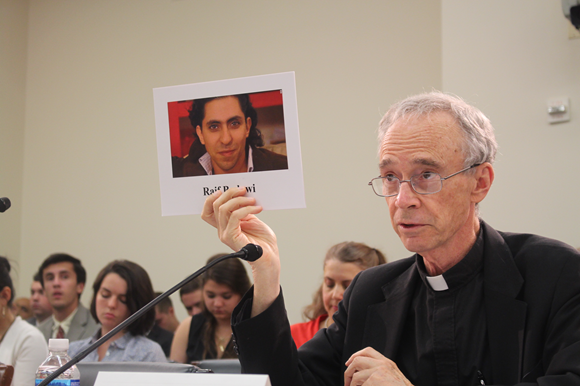
(USCIRF Chair Thomas J. Reese, S.J. holds up a picture of Raif Badawi at a July 2016 Tom Lantos Human Rights Commission hearing on blasphemy laws)
WASHINGTON, D.C. – The U.S. Commission on International Religious Freedom (USCIRF) sadly marks the three-year anniversary of the blasphemy sentence handed down in Saudi Arabia to Raif Badawi, the founder and editor of Free Saudi Liberals, an online forum for diverse views.
“The Saudi government continues to imprison Raif Badawi for exercising his internationally-guaranteed rights of the freedoms of religion and expression. Mr. Badawi is a prisoner of conscience who has languished in prison, away from his wife and children, and has been flogged publicly to punish him and intimidate others,” said USCIRF Chair Thomas J. Reese, S.J. “USCIRF calls on the Saudi government to overturn his unjust sentence, release him immediately and unconditionally, and end the prosecution of individuals charged with apostasy and blasphemy. Belief must not be policed.”
Mr. Badawi was arrested in June 2012 on crimes including apostasy and “insulting Islam” and sentenced on July 29, 2013 to seven years in prison and 600 lashes. In May 2014, a Saudi appeals court retried Mr. Badawi’s case, resulting in a harsher sentence, which the Saudi Supreme Court upheld in June 2015: 10 years’ imprisonment, 1,000 lashes, and a fine roughly equivalent to US$266,000.
On January 9, 2015, Badawi received the first set of 50 lashes. Immediately after the flogging was carried out, several governments (including the United States), USCIRF, and numerous international human rights groups and individual advocates condemned the sentence’s implementation. Badawi has not received additional flogging, partly due to international outrage and partly due to a medical doctor’s finding that he could physically not endure more lashings. Nevertheless, Badawi remains in prison, along with his lawyer, Waleed Abu al-Khair, who was sentenced in July 2014 by a newly created anti-terror court to 15 years in jail after being found guilty of various trumped-up charges related to his work as a human rights defender.
USCIRF sent a letter in June 2015 to Saudi King Salman requesting Raif Badawi’s pardon. USCIRF Chair Reese raised the case of Raif Badawi during a Tom Lantos Human Rights Commission hearing on blasphemy laws.
The Saudi government continues to use criminal charges of apostasy and blasphemy to suppress discussion and debate and silence dissidents. Promoters of political and human rights reforms and those seeking to debate the role of religion in relation to the state, its laws, and society typically have been the targets of such charges.
USCIRF again recommended in May 2016 that Saudi Arabia be designated as a Country of Particular Concern (CPC) for systematic, ongoing, and egregious violations of religious freedom. The State Department has designated Saudi Arabia as a CPC since 2004. However, since 2006, the Department has put an indefinite waiver on taking any action in consequence of the CPC designation. USCIRF continues to urge the U.S. government to lift the waiver.
To interview a Commissioner, please contact USCIRF at [email protected] or 202-786-0615.
Jul 8, 2016
FOR IMMEDIATE RELEASE
July 8, 2016
WASHINGTON, D.C. – Russian President Vladimir Putin on July 7 signed into law a package of anti-terrorism measures the Russian State Duma passed in late June. The U.S. Commission on International Religious Freedom (USCIRF) strongly condemns these measures. Under the guise of confronting terrorism, they would grant authorities sweeping powers to curtail civil liberties, including setting broad restrictions on religious practices that would make it very difficult for religious groups to operate. On June 23, President Putin signed into law yet another problematic measure: It authorizes the police to arrest people suspected of violating “generally accepted norms of social behavior,” thereby giving authorities another weapon to use against disfavored groups, including religious organizations.
“These deeply flawed anti-terrorism measures will buttress the Russian government’s war against human rights and religious freedom,” said USCIRF Chair Thomas J. Reese, S.J. “They will make it easier for Russian authorities to repress religious communities, stifle peaceful dissent, and detain and imprison people. Neither these measures nor the currently existing anti-extremism law meet international human rights and religious freedom standards.”
The anti-terrorism measures would, among other provisions, amend the 1997 Russian religion law by redefining “missionary activities” as religious practices that take place outside of state-sanctioned sites. The new law thus would ban preaching, praying, proselytizing, and disseminating religious materials outside of these officially-designated sites, and authorize fines of up to $15,000 for these activities conducted in private residences or distributed through mass print, broadcast or online media. Foreign missionaries also must prove they were invited by state-registered religious groups and must operate only in regions where their sponsoring organizations are registered; those found in violation face deportation and major fines.
The Russian government uses its current anti-extremism law to target religious communities because the legal definition of extremism does not require the threat or use of violence. “Extremism” charges can include the peaceful promotion of “the superiority of one’s own religion,” and have resulted in religious texts being banned and members of non-violent Muslims groups and Jehovah’s Witnesses imprisoned. The proposed anti-terrorism measures would increase prison terms under the current extremism law.
USCIRF placed Russia on its Tier 2 list in its 2016 Annual Report. In Tier 2 countries, the violations the government engages in or tolerates are serious and characterized by at least one of the elements of IRFA’s “systematic, ongoing, and egregious” standard. For more information, please refer to the Russia chapter in USCIRF’s 2016 Report (in English and in Russian).
To interview a Commissioner, please contact USCIRF at [email protected] or 202-786-0615.
Jul 6, 2016
FOR IMMEDIATE RELEASE
July 6, 2016
WASHINGTON, D.C. – As Muslims around the world mark the end of Ramadan with Eid al-Fitr celebrations, the U.S. Commission on International Religious Freedom (USCIRF) strongly condemns the Chinese government’s restrictions on Uighur and other Muslims’ religious practices. These restrictions are particularly egregious during this month-long period of introspection, fasting, prayer, and devotion.
“The Chinese government once again has banned government employees, students, and children from fasting, and in some cases praying, during Ramadan,” said USCIRF Chair Thomas J. Reese, S.J. “While restrictions on Uighur Muslims’ religious practices take place year round, they are particularly onerous during Ramadan, giving lie to the government’s claim that Uighur Muslims in Xinjiang enjoy religious freedom. They do not. The Chinese government is violating its own constitution and international human rights standards by denying religious freedom to its citizens.”
The government imposed Ramadan restrictions this year after it issued a June white paper, Freedom of Religious Belief in Xinjiang, that highlights the supposed religious freedom experienced by people of the Xinjiang Uighur Autonomous Region, where the majority of China’s Uighur Muslim population lives. The paper alleges that the government protects “normal” religious activities and respects citizens’ religious needs and customs.
Rather than recognize that the vast majority of Uighur Muslims peacefully practice their faith, Chinese regional and central governments treat the entire Uighur community as potential violent terrorists whose “extreme religious activities” must be monitored, controlled, and restricted.
To these ends, local authorities throughout the year seek to ban any visible Islamic expression, including men’s beards and women’s face-covering veils, and prohibit children under 18 from practicing any religion. Authorities also regularly surveil mosques and harass religious adherents.
The government’s crackdown since 2009 on religious activities and expression in Xinjiang has led to the detention and deaths of hundreds of Uighur Muslims, fueling resentment and the very extremism the government claims it is trying to quell.
For more information, please see USCIRF’s China chapter in the 2016 Annual Report (in English and Chinese). See also the following press release about Professor Ilham Tohti’s life sentence: USCIRF Calls on the Release of Ilham Tohti and other Prisoners of Conscience.
To interview a USCIRF Commissioner, please contact USCIRF at [email protected] or 202-786-0615.