Nov 2, 2015
FOR IMMEDIATE RELEASE
Washington, D.C. – The U.S. Commission on International Religious Freedom (USCIRF) today criticized the Tajik government’s ongoing efforts to control religious activities, especially those of the country’s majority Muslim population. These efforts include the recent ban of the Islamic Renaissance Party of Tajikistan (IRPT) due to allegations of extremism, the arrest of some 200 IRPT activists, and the alleged torture and other human rights abuses committed against IRPT detainees.
“The government’s suppression of independent religious activities provides yet another example of the Tajik government using its overly broad extremism law against peaceful and independent Islamic religious activity or affiliation, a counterproductive approach that risks increasing radicalization rather than reducing it. USCIRF believes that these actions, along with its ban of the IRPT, should guarantee Tajikistan a CPC designation from the State Department, a designation which USCIRF recommends in our 2015 Annual Report. Official efforts to suppress the IRPT often have been intertwined with government repression of Islamic practice. USCIRF urges Secretary of State Kerry to raise religious freedom concerns when he arrives tomorrow in Tajikistan,” said USCIRF Chairman Robert P. George.
The legal environment for religious freedom in Tajikistan has deteriorated recently, largely to the implementation of the 2009 religion law which: establishes onerous registration requirements for all religious groups; criminalizes all unregistered religious activity as well as private religious education and proselytism; requires official permission for religious groups to provide religious instruction and communicate with foreign co-religionists; and imposes state controls over the content, publication, and import of all religious materials.
The Tajik government imposes additional restrictions on Muslims such as: limiting the number and size of mosques; closing hundreds of unregistered mosques and prayer rooms; and demolishing three unregistered mosques in Dushanbe. The Tajik government pays imams’ salaries in the largest mosques and restricts the preaching of sermons to these mosques. Muslim prayer officially is allowed only in mosques, cemeteries, homes, and shrines. As of October 2015, Tajik authorities reportedly are prohibiting government employees from attending Friday prayers.
The IRPT was the only legal Islamist political party in the former Soviet Union. It was granted such status as part of the country’s post-civil war peace settlement, and for 15 years was represented in Tajikistan’s parliament. The IRPT called for respecting Tajikistan’s secular constitution and international religious freedom commitments. It opposed the government’s decision in 2005 to close eight mosques near the Uzbek border and its destruction in 2007 of mosques in the capital, Dushanbe. Last year, the IRPT backed a parliamentary initiative that would allow children to attend mosques, which Tajik law currently forbids, and in 2015 it criticized a government campaign against beards and headscarves.
The 200 IRPT members imprisoned since September include former parliamentarian Saidumar Husaini, IRPT Deputy Chair Mahmadali Hait, journalist Hikmatulloh Saifullohzoda, Islamic scholar Zubaidullah Roziq, and many IRPT regional activists. They have been denied access to their families, doctors, and lawyers. The day after jailed IRPT deputy chairman Saidumar Husain told Buzurgmehr Yorov, his defense attorney, that he had been tortured, Yorov was arrested as was another IRPT attorney. Jailed IRPT lawyer Zarafo Rahmoni reportedly has been severely abused and had threatened to commit suicide unless she was released. IPRT leader Muhiddin Kabiri, forced into foreign exile, asserted that official extremism charges against his party were false and politically motivated. Several days ago, many of Kabiri’s relatives and his driver were tortured into confessing involvement in a deputy Tajik defense minister’s violent attack on a police station.
The U.S. delegation to the Organization for Security and Cooperation in Europe (OSCE) and the Office of the UN High Commissioner for Human Rights, among others, also have expressed concern about the Tajik government’s actions against the IRPT. USCIRF has recommended since 2012 that Tajikistan be named a “country of particular concern” (CPC) under the International Religious Freedom Act (IRFA) because of its numerous harsh laws and policies that severely restrict freedom of religion or belief.
To read USCIRF’s 2015 Annual Report chapter on Tajikistan, click here.
Oct 28, 2015
FOR IMMEDIATE RELEASE
October 28, 2015
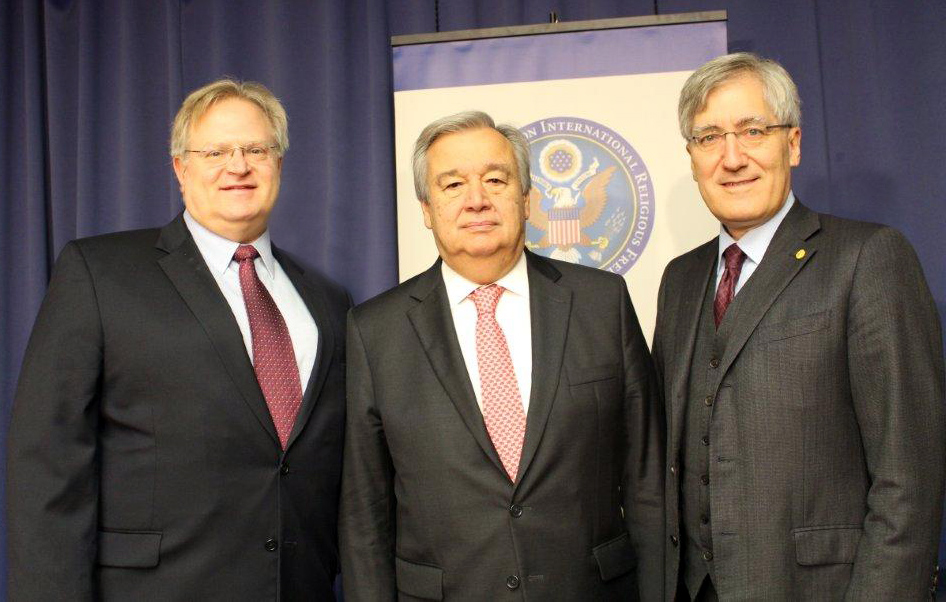
WASHINGTON, D.C. – UN High Commissioner for Refugees Antonio Guterres participated in a timely conversation yesterday hosted by the U.S. Commission on International Religious Freedom (USCIRF). The conversation focused on the urgent refugee crisis taking place in Syria and across many parts of the world, the role of religious freedom violations in this crisis, and policies that best would address conflicts and their humanitarian consequences.
USCIRF Chairman Robert P. George gave opening comments and USCIRF Vice Chairman Eric Schwartz moderated the conversation with High Commissioner Guterres.
According to UNHCR, by the end of 2014 almost 60 million people forcibly were displaced from their homes, the highest number since World War II. Displaced people worldwide are fleeing war, political oppression, and religious persecution. Syria’s 4 million refugees and 7.5 million internally displaced people makes that nation the largest producer in the world of displaced persons.
For more information on USCIRF’s refugee recommendations please click here. The conversation can be accessed here.
To interview a USCIRF Commissioner, please contact Travis Horne at [email protected] or 202-786-0615.
Oct 27, 2015
FOR YOUR INFORMATION
October 27, 2015 | Robert P. George and Eric P. Schwartz
The following op-ed appeared in The Hill on October 27, 2015
Today, Oct. 27, is International Religious Freedom Day, which this year marks the 17th anniversary of the enactment of the International Religious Freedom Act of 1998 (IRFA).
IRFA created a first-ever international religious freedom office in the State Department. It also established the U.S. Commission on International Religious Freedom (USCIRF), on which we serve, as an independent, non-partisan entity to monitor religious freedom abroad and make recommendations to the president, secretary of State, and Congress.
Less than two weeks ago, on Oct. 16, President Obama signed a bill -- passed by Congress on Oct. 6 -- reauthorizing USCIRF for another four years.
We are grateful that Congress and the president have enabled USCIRF to continue its important work at a time of maximum need:
According to several Pew studies, most of the people in the world live in countries that seriously violate this liberty.
As we indicated in our latest annual report, which was released this past spring, religious freedom conditions worldwide have not improved, and situations remain particularly dismal in countries we cited as perpetrating or tolerating the worst abuses. Such nations include those our Commission recommended that the State Department designate as “countries of particular concern” (CPC), marking them as the world’s most severe violators. They also included those we listed as Tier 2 countries due to violations that, while not rising to CPC status, remain serious.
When we reviewed the 16 countries we recommended last year for CPC status, we saw little improvement and in many cases, signs of further deterioration. In addition to recommending again this year these 16 as the most severe violators, the Commission was compelled to add a 17th country to our list – Central African Republic.
Regarding Tier 2 countries, religious freedom conditions likewise remain troubling. Russia’s continued failure to respect religious minorities at home and in territories it has occupied merits its Tier 2 status.
This process of publicly designating the worst violators is a valuable tool in the effort to promote religious freedom. By bearing witness in this public way, we keep faith with victims, rally support for their rights, and bring pressure to bear against government violators by publicly shaming them for abusing basic rights.
Across the world, religious freedom violators consist of state and non-state actors.
Some state actors, like China and North Korea, are secular tyrannies which suppress religious groups across the board. Others, like Iran and Saudi Arabia, enthrone a single religion or religious interpretation, while persecuting those embracing alternatives.
These state actors abuse religious freedom in many ways, including imprisoning people due to their religious beliefs, actions, or advocacy.
China, for example, handed Ilham Tohti, a respected Uighur Muslim scholar, a life sentence for alleged “separatism.” Iran keeps hundreds of people, from Baha’is to Christians, Sufi and Sunni Muslims to Shi’a Muslim reformers and clerics, imprisoned for reasons relating to religion.
Not even electoral democracies are immune from holding religious prisoners. In Pakistan, which a USCIRF delegation visited for the first time in March, more people like Aasia Bibi, a Christian farm hand, are on death row or serving life sentences for blasphemy than anywhere else.
Pakistan’s blasphemy laws not only violate freedom of religion and expression; they embolden extremists to assault perceived transgressors. These attackers have increasingly victimized Pakistan’s religious minorities, from Shi’a to Christians, Hindus to Ahmadis.
For these reasons, we have urged the State Department to designate Pakistan a CPC.
Over the past year, non-state actors have been fueling some of the worst humanitarian crises of our time. Among them is ISIL. From Yazidis to Christians, Shi’a to dissenting Sunnis, no religious group has been free of ISIL’s depredations in Syria and Iraq.
Beyond Iraq and Syria, non-state actors have been wreaking similar havoc.
Boko Haram has cut a wide path of terror across Nigeria, which a USCIRF delegation visited in May.
In Burma, which a USCIRF delegation visited in August 2014, Buddhist extremists have assaulted Rohingya Muslims.
And in Central African Republic, fighting between Christians and Muslims has destroyed nearly every mosque in the country.
And in many of these countries, governments – by aligning themselves with particular religious groups and discriminating against others in their efforts to sustain their power – have fostered conditions leading to abuses by non-state actors from the Middle East to Asia.
As we mark International Religious Freedom Day, we believe that in spite of the bleak landscape for liberty, the desire for greater freedom burns brightly in people’s hearts.
Thanks to timely action by our executive and legislative branches, USCIRF will keep promoting religious freedom, prioritizing the sacred rights and solemn duties of conscience.
George serves as chairman of the U.S. Commission on International Religious Freedom (USCIRF). Schwartz serves as a USCIRF vice chairman.