
May 13, 2015
FOR IMMEDIATE RELEASE
May 13, 2015 | USCIRF
WASHINGTON, D.C. – The U.S. Commission on International Religious Freedom (USCIRF) today commemorates the 10th anniversary of the Andijon massacre. On May 13, 2005, as many as 1,000 people were killed when Uzbek soldiers fired indiscriminately and without warning into a crowd of demonstrators in the city of Andijon during a largely peaceful protest in support of 23 local businessmen on trial for alleged ties to Islamic extremism.
“The Andijon tragedy is a black mark which will remain until the Uzbek government allows a credible investigation of this tragic event and undertakes the necessary reforms to respect religious freedom and human rights,” said USCIRF Chair Dr. Katrina Lantos Swett. “While Uzbekistan faces legitimate security concerns, these concerns cannot be used as excuses to violate the religious freedom and human rights of its citizens.”
In the aftermath of the Andijon massacre, Uzbek authorities ignored calls for an international investigation and jailed hundreds of local residents, human rights activists, and journalists. USCIRF observed in its recently released 2015 Annual Report that the Uzbek government’s harsh campaign against those Muslims who are independent from state-sanctioned Islam continues as it targets those linked to the May 2005 Andijon protests. The government also has imprisoned 231 people for their alleged connection to this event, including ten prisoners who died in detention. Uzbekistan also continues to pressure countries to return Uzbek refugees who fled after the Andijon tragedy.
“Uzbekistan represents one of the worst nations in the world for religious freedom. The State Department since 2006 has named Uzbekistan as a ‘country of particular concern' for its systematic, ongoing, and egregious violations of religious freedom. The U.S. and international community must condemn the Uzbek government for its culpability in the tragic events related to Andijon and ongoing government repression of religious freedom and related human rights,” concluded Dr. Lantos Swett.
The 2015 USCIRF Annual Report also noted that the government of Uzbekistan imprisons individuals who do not conform to officially-prescribed practices or whom it claims are extremist, including as many as 12,000 Muslims. USCIRF has called for the U.S. Government to make U.S. assistance – except for humanitarian assistance and human rights programs – contingent on the Uzbek government’s adoption of specific actions to improve religious freedom conditions and comply with international human rights standards, including reforming the 1998 religion law and permitting an international investigation into the 2005 Andijon events.
Click here to view the full 2015 Annual Report.
View the Uzbekistan chapter in English, Uzbek or Russian.
To interview a USCIRF Commissioner, please contact USCIRF at [email protected] or 202-786-0613.
Apr 30, 2015
FOR IMMEDIATE RELEASE
April 30, 2015 | USCIRF
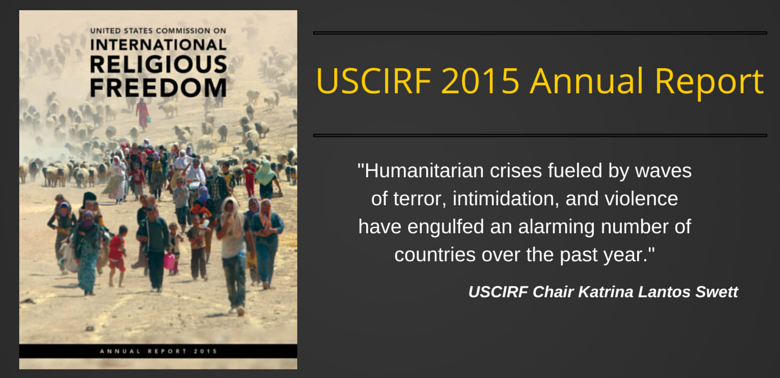
Washington, D.C. – The U.S. Commission on International Religious Freedom (USCIRF) today released its 2015 Annual Report. This year’s report, the 16th since the Commission’s creation in 1998, documents religious freedom violations in 33 countries, makes country-specific recommendations, and assesses the U.S. government’s implementation of the International Religious Freedom Act (IRFA).
"Not a day goes by without at least one country from these lists appearing on the front page of a major newspaper. Humanitarian crises fueled by waves of terror, intimidation and violence have engulfed an alarming number of countries over the past year,” said USCIRF Chair Dr. Katrina Lantos Swett.
“With serious religious freedom violations occurring all around the world, these horrors speak volumes about how and why religious freedom and the protection of the rights of vulnerable religious communities matter. All nations should care about abuses beyond their borders not only for humanitarian reasons but because what goes on in other nations rarely remains there. The full recognition of religious freedom is a critical guarantor of the safety, security and survival of the persecuted and vulnerable.”
USCIRF, in its role as an independent U.S. federal government advisory body, recommends that the State Department add eight more nations to its list of “countries of particular concern,” or CPCs, where particularly severe violations of religious freedom are perpetrated or tolerated. These countries are:
- Central African Republic (first time recommendation)
- Egypt
- Iraq
- Nigeria
- Pakistan
- Syria
- Tajikistan
- Vietnam
USCIRF also recommends that the State Department redesignate as CPCs the following nine countries and take additional actions to promote religious freedom:
Along with recommending CPC designations, USCIRF also places 10 countries on its 2015 “Tier 2” list, a Commission designation for governments that engage in or tolerate violations that are serious but not CPC-level. USCIRF urges increased U.S. government attention to the following countries:
The USCIRF Report also highlights religious freedom concerns in countries that do not meet Tier 1 (CPC) or Tier 2 thresholds, but should also be the focus of concern. These countries are:
Click here to view the full 2015 Annual Report.
Join the conversation on Twitter by using #USCIRF2015
To interview a USCIRF Commissioner, please contact USCIRF at [email protected] or 202-786-9812.
Apr 23, 2015
FOR IMMEDIATE RELEASE
April 23, 2015 | USCIRF
WASHINGTON, D.C. – The U.S. Commission on International Religious Freedom (USCIRF) today solemnly marks the 100 year anniversary of the tragic killing of over one million Armenians in what is now modern-day Turkey. USCIRF recognizes the profound significance of this day and the deep wounds it continues to evoke for the Armenian people, and the other religious and ethnic communities who were victims of the horrible events of 1915.
USCIRF is an independent, bipartisan U.S. federal government advisory commission that issues reports, recommendations, and statements independent of the executive branch.
“During World War I, in the waning days of the Ottoman Empire, Turkish forces motivated by extreme nationalist fervor systematically killed and deported Armenians, Greek Orthodox Christians, Assyrian Christians, and others,” said USCIRF Vice Chair, James J. Zogby.
Historians, religious leaders, and many governments recognize that well over one million people were killed or died. Most recently, during a Sunday mass commemorating the anniversary, Pope Francis said that the 1915 events were “the first genocide of the 20th century.”
“Remembering and acknowledging the terrible evil that took place 100 years ago is especially important given the crimes against humanity – including acts of genocide, ethnic cleansing and religiously-motivated violence – that are taking place today in many parts of the world, especially in Syria and Iraq. On this day, the United States government and all like-minded countries that believe in the fundamental importance of human rights and religious freedom should state publicly and clearly that perpetrators of such heinous crimes will be held accountable,” stated USCIRF Vice Chair, Robert P. George.
“Our hope is that on this day individuals, religious and ethnic communities, and governments around the world will reflect deeply on this dark chapter in world history. Without open acknowledgement that these events took place and their significance, a new sense of mutual reconciliation and collaboration will not emerge,” said USCIRF Chair, Dr. Katrina Lantos Swett.
USCIRF, an independent U.S. government commission, was created to monitor religious freedom violations abroad, and provide policy recommendations to the United States government on ways international religious freedom can be best protected, promoted, and improved through U.S. foreign policy. USCIRF’s 2015 Annual Report will be released on April 30th and will be found at www.uscirf.gov.
To interview a USCIRF Commissioner, please contact USCIRF at [email protected] or 202-786-0613.