Jan 12, 2007
FOR IMMEDIATE RELEASE
January 12, 2007
Contact:
Judith Ingram, Communications Director,
(202) 523-3240, ext. 127
cell (202) 375-3787
Bangladesh: Decision to Postpone Election Offers a Second Chance
WASHINGTON-The U.S. Commission on International Religious Freedom commends the caretaker government of Bangladesh for postponing the Jan. 22 national election, noting that the election's shortcomings had sparked street violence and imperiled the political future of the world's fourth largest Muslim majority nation.
As a democracy with a vibrant civil society and a constitution that enshrines universal human rights norms, including the freedom of religion or belief, Bangladesh could be a model for other emerging democracies with majority Muslim populations.
But the election was tainted by widespread allegations of unfairness and partiality among election officials. A study by the U.S. National Democratic Institute found 13 million more names on the voter rolls than would be eligible according to Bangladesh's population. Election officials, in spite of repeated urging, had failed to correct the errors, which could have severely biased the results.
There had also been repeated allegations that eligible voters from minority religious communities were excluded from the registration process. In the Commission's view, such concerns are well founded in light of the ethnic and religious violence that attended Bangladesh's last general election, in October 2001.
Representatives of those minorities had told a Commission delegation to Bangladesh last year of severe anti-minority discrimination in such areas as employment, property rights, and access to the legal system, as well as electoral disenfranchisement.
"Bangladesh was far from ready to conduct a free and fair vote," said Felice D. Gaer, who chairs the Commission, a bipartisan, independent federal agency. "The caretaker government should be commended for taking the principled position to take a time-out in order to fix the voter lists. Bangladesh now has a second chance, and the caretaker government must not squander it."
The postponement is just the start of the effort needed to calm the political unrest and safeguard Bangladeshi democracy. International help will be crucial.
The U.S. Government should urge Bangladesh's caretaker government to:
- set a tight deadline of 60-90 days to correct the voter rolls to ensure that extra names are deleted and other voters are not disenfranchised, and to hold a free and fair election;
- establish a bipartisan body to lead the correction process in order to restore Bangladeshis' faith in the democratic process;
- use transparent and numbered ballot boxes, prevent campaign and election-day violence and punish the perpetrators in order to ensure the integrity of the election; and
- take steps to satisfy the requirements of monitors from the European Union, U.S. National Democratic Institute and International Republican Institute and election experts from the United Nations, all of whom refused to offer legitimacy to such a severely flawed election.
The election will be key in determining the future of the democracy of 140 million, and the repercussions will be felt throughout the South Asia region and the Islamic world.
The U.S. Commission on International Religious Freedom has closely followed developments in Bangladesh, which it has put on its Watch List of countries that require intense monitoring for violations of religious freedom.
For more information on the situation, see the Policy Focus on Bangladesh on the Commission's Web site: www.uscirf.gov.
The U.S. Commission on International Religious Freedom was created by the International Religious Freedom Act of 1998 to monitor the status of freedom of thought, conscience, and religion or belief abroad, as defined in the Universal Declaration of Human Rights and related international instruments, and to give independent policy recommendations to the President, the Secretary of State and the Congress.
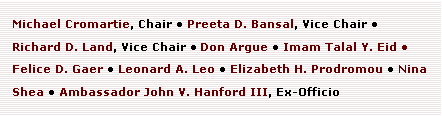
| Felice D. Gaer,Chair•Michael Cromartie,Vice Chair•Elizabeth H. Prodromou, Vice Chair•Nina Shea,Vice Chair•Preeta D. Bansal•Archbishop Charles J. Chaput•Khaled Abou El Fadl•Richard D. Land•Bishop Ricardo Ramirez•Ambassador John V. Hanford III,Ex-Officio•Joseph R. Crapa,Executive Director |
Jan 11, 2007
FOR IMMEDIATE RELEASE
January 11, 2007
Contact:
Judith Ingram, Communications Director,
(202) 523-3240, ext. 127
-EVENT ADVISORY-
Religious Freedom and State Policy in Central Asia
Featuring:
Igor Rotar, Central Asia Correspondent, Forum 18 News Service
Eric McGlinchey, Assistant Professor, George Mason University
Catherine Cosman,Senior Analyst, U.S. Commission on International Religious Freedom
Chair:
Cory Welt, Deputy Director and Fellow, Russia and Eurasia Program,
Center for Strategic and International Studies (CSIS)
Thursday, January 11, 2007
2:00 p.m. - 3:30 p.m.
Center for Strategic and International Studies
1800 K Street N.W., Lower Level, Conference Room B1A
RSVP:Russia and Eurasia Program, CSIS: [email protected] or (202)775-3259
The CSIS Russia and Eurasia Program and the U.S. Commission on International Religious Freedom invite you to a briefing onThursday, January 11, 2007 at 2:00 p.m.on religious freedom and state policy in Central Asia.
Our speakers include three specialists on state and religion in Central Asia: Igor Rotar is a seasoned researcher of religious and ethnic conflict in Eurasia, and has been an analyst and reporter for the Norway-based Forum 18 News Service since 2003. Eric McGlinchey is Assistant Professor of Government and Politics at George Mason University; his areas of research include comparative politics, Central Asian regime change, political Islam, and the effects of Information Communication Technology (ICT) on state and society. Catherine Cosman has served as the Senior Policy Analyst for the OSCE region at USCIRF since 2003; she has also worked at RFE/RL, OSCE, Human Rights Watch, and the U.S. Commission on Security and Cooperation in Europe. The discussion will be chaired by Cory Welt, CSIS Russia and Eurasia Program Deputy Director and Fellow.
The U.S. Commission on International Religious Freedom was created by the International Religious Freedom Act of 1998 to monitor the status of freedom of thought, conscience, and religion or belief abroad, as defined in the Universal Declaration of Human Rights and related international instruments, and to give independent policy recommendations to the President, the Secretary of State and the Congress.
| Felice D. Gaer,Chair•Michael Cromartie,Vice Chair•Elizabeth H. Prodromou, Vice Chair•Nina Shea,Vice Chair•Preeta D. Bansal•Archbishop Charles J. Chaput•Khaled Abou El Fadl•Richard D. Land•Bishop Ricardo Ramirez•Ambassador John V. Hanford III,Ex-Officio•Joseph R. Crapa,Executive Director |
Jan 3, 2007
FOR IMMEDIATE RELEASE
January 03, 2007
Contact:
Angela Stephens, Assistant Communications Director,
(202) 523-3240, ext. 114
WASHINGTON-The sudden death of Turkmenistan's President Saparmurat Niyazov on December 21 represents an extraordinary opportunity for the United States to encourage desperately needed human rights reforms, respect for the rule of law, and the conduct of fully free and fair elections in the strategic Central Asian republic, one of the world's most repressive states. Such improvements are vital to the protection of human rights and for Turkmenistan's long-term stability.
The U.S. Commission on International Religious Freedom, an independent, bipartisan federal agency, recommends that the U.S. government insist that the transitional leadership in Turkmenistan act immediately to reverse Niyazov's gross abuses of human rights, including freedom of thought, conscience, and religion or belief. Since 2000, the Commission has called for Turkmenistan to be designated a Country of Particular Concern by the Department of State due to the Turkmenistan government's consistent and flagrant disregard of its commitments with respect to freedom of religion or belief.
The United States should encourage the new government of Turkmenistan to end Niyazov's personality cult, which had reached the dimensions of a state-imposed religion; halt the government's interference with, and excessive control over, religious activities and organizations; and bring the country's religion law into conformity with Turkmenistan's Constitution and its international legal commitments, particularly Article 18 of the International Covenant on Civil and Political Rights. The Commission calls on the White House and the Senate to move quickly to send a new U.S. ambassador to Turkmenistan to work with the new Turkmen authorities as they undertake a thorough reform of current laws and practices that undermine freedom of religion and related human rights.
The excesses of the Turkmenistan government under President Niyazov have been widely condemned in UN resolutions and by independent treaty monitoring bodies and experts. In October 2006, the UN Secretary General reported to the General Assembly that "gross and systematic violation of human rights continued ... notwithstanding the gestures made by the [Turkmenistan] government.
The Commission recommendsthat the U.S. government urge the new authorities in Turkmenistan to undertake the following critical reforms with regard to ensuring human rights, democracy, and the rule of law:
- Dismantle the personality cult of former President Niyazov, eliminate the requirement that the Rukhnama-a book of Niyazov's "spiritual thoughts"-be quoted and displayed in mosques, and drop the Rukhnama from the curricula;
- Conduct fully free and fair presidential and parliamentary elections;
- Immediately put an end to the country's practices that repress freedom of thought, conscience, and religion or belief. These changes include (1) ending harassment and deportation of religious leaders; (2) halting unjust arrest, detention, imprisonment, torture, and residential and workplace intimidation of religious leaders and their adherents; (3) releasing immediately and unconditionally any persons who have been detained solely because of their religious beliefs, practices, or choice of religious association, including Nazrullah ibn Ibadullah, the country's former chief mufti; and (4) investigating all cases of reported harassment, raids, and destruction of houses of worship, and holding those responsible to account.
- Adopt thorough reform of the country's policies toward religion, including ending state interference in the selection, training, and management of religious communities, including those of Sunni and Shia Muslims and the Russian Orthodox Church, and Protestant and other minority communities, and ensure freedom of religion or belief for every individual; dropping imprisonment or fines of individuals who engage in unregistered religious activities; allowing children to receive religious education; allowing the publication and distribution of religious literature inside Turkmenistan; and permitting freedom of movement for individuals, including members of all religious communities.
- Invite the 10 experts of the UN Special Procedures on Human Rights, in response to their longstanding requests for visits, and answer the outstanding communications they have sent regarding specific alleged violations. These experts include the Special Rapporteur on Freedom of Religion or Belief, as well as special procedures (rapporteurs, working groups, etc.) on Freedom of Expression; Torture; Extra-judicial, summary or arbitrary executions; Independence of the Judiciary; the Right to Education; Right to Health; Internally Displaced Persons; Human Rights Defenders; and the Working Group on Arbitrary Detention. In addition, invite representatives of the Organization for Security and Cooperation in Europe's (OSCE's) Panel of Experts on Freedom of Religion or Belief. Turkmenistan should provide the full and necessary conditions for such visits.
The Commission further recommendsthat, in the longer term, the U.S. government conduct a full review and evaluation of its international programs to ensure that the advancement and promotion of respect for human rights and fundamental freedoms in Turkmenistan including the right to freedom of thought, conscience, and religion or belief is a top strategic policy priority. Among the elements that could be adopted or expanded are the following:
- Increase radio, Internet, and other broadcasts of objective news and information, including educational topics, human rights, freedom of religion, and tolerance;
- Develop programs to encourage effective civil society groups that protect human rights and promote religious freedom;
- Increase exchange programs, including civil society leaders, students, and others concerned with human rights;
- Expand dissemination of information about human rights and democratic freedoms, including through "American corner" reading rooms in various regions;
- Expand "train-the-trainer" legal assistance programs for representatives of religious communities to act as legal advisers in the registration process;
- Specify freedom of thought, conscience, and religion as a grants category and area of activity in the Democracy and Conflict Mitigation program of the U.S. Agency for International Development and the Democracy Commission Small Grants program administered by the U.S. Embassy.
The Commission recommends that the U.S. government also support the following actions in international bodies with regard to Turkmenistan:
- Expand the activities of the OSCE Center in Ashgabat, particularly in regard to human rights, tolerance, and freedom of religion or belief, including programs with local schools, universities and non-governmental organizations. The Commission welcomes the recent statement by the OSCE Chairman-in-Office to the new leadership in Turkmenistan offering assistance.
- Encourage the new government of Turkmenistan to abide by the numerous recommendations of the October 2006 Report of the UN Secretary General on the Situation of Human Rights in Turkmenistan, and the conclusions of the independent treaty bodies to which Turkmenistan has formally reported.