Apr 10, 2008
FOR IMMEDIATE RELEASE
April 15, 2008
Contact: Judith Ingram,
Communications Director,
(202) 523-3240, ext. 127
A Prison Without Bars: Refugee and Defector Testimonies of Severe Violations of Freedom of Religion or Belief in North Korea
Tuesday, April 15, 2008, 1-2 p.m.
Cannon House Building, Room 340
WASHINGTON- The United States Commission on International Religious Freedom will release its updated report on religious freedom and related human rights in North Korea, entitled A Prison Without Bars: Refugee and Defector Testimonies of Severe Violations of Freedom of Religion or Belief in North Korea, at a press conference the day before South Korean President Lee Myung Bak is scheduled to arrive in Washington, D.C. for a summit with President Bush. The discussion of the report, with Commission Chair Michael Cromartie and Commissioners Nina Shea and Imam Talal Y. Eid, will be followed by a briefing, co-sponsored by the Congressional Korea Caucus.
A Prison Without Bars offers fresh evidence regarding the grave situation of North Korean asylum seekers who have been forcibly repatriated from China back to North Korea. Contrary to claims made by the Chinese government, repatriated North Koreans face severe persecution, including harsh interrogations, long-term imprisonment, and torture if they are found to have converted to Christianity or had contact with South Korean Christians or churches while in China. The report provides evidence that the cult of personality surrounding Kim Jong Il and his family remains strong, and that Kim Jong Il's regime perceives any new religious activity as a security threat to be combated at all costs. As a result, stringent security measures have been enacted to stop the spread of religion, mostly Protestantism, through cross-border contacts with China.
A Prison Without Bars follows up the Commission's 2005 study on North Korea's brutal suppression of religious freedom, Thank You Father Kim Il Sung. The Commission's new report again presents the opportunity to gain insight into human rights conditions in the "Hermit Kingdom" by providing a channel for North Korean nationals to present their experiences to the international community.
According to refugees interviewed for the report:
-
Apart from churches and temples in Pyongyang meant most to impress foreign tourists and guests, elements of Buddhism, Christianity, and traditional folk beliefs continue to exist in North Korea, in spite of the repression. Certain practices within Shamanism, such as fortune-telling, are widely practiced in defiance of government bans.
-
Conditions along the China-North Korea border are uniquely hazardous for North Korean refugees, as security agents target refugees believed to have visited Chinese churches for food aid or other forms of immediate assistance.
-
Refugees who admit under intense interrogation to having had contact with Christians while in China often receive particularly harsh punishments. As a result, many North Korean refugees must consciously avoid revealing any knowledge of Christianity or contact with China-based Christians.
According to former North Korean security agents, who were also interviewed for this report:
-
There is increased police activity aimed at halting religious activities in the border regions with China-including setting up of mock prayer meetings to entrap new converts in North Korea, and training security agents in Christian traditions and practices for the purposes of infiltration of churches in China.
-
North Korean security agents overseeing the detention and often brutal interrogation of North Korean refugees classify their efforts as "counterintelligence work," as it is believed that South Korean missionary activities aimed towards North Korean refugees is a cover for conducting espionage.
-
The North Korean dictatorship draws a distinction between recent converts who acquired religion while in China, and "old believers," whose families have been multi-generational religious devotees. New religious converts are targeted for especially stringent punishments.
Immediately following the press conference, the Commission will conduct a congressional briefing on human rights in North Korea, jointly sponsored with the Congressional Korea Caucus. The briefing will feature David Hawk, a Reagan-Fascell Fellow at the National Endowment for Democracy; Peter Beck, Executive Director of the U.S. Committee for Human Rights in North Korea; and Jae Ku, Executive Director of the U.S.-Korea Institute at the School for Advanced International Studies, Johns Hopkins University. Several Members of Congress are also expected to participate in the briefing.
Apr 9, 2008
FOR IMMEDIATE RELEASE
April 9, 2008
Contact: Judith Ingram,
Communications Director,
(202) 523-3240, ext. 127
Tuesday, April 15, 2008, 1-3:30 pm
Cannon House Building, Room 340
1 pm: Release of USCIRF Report:
A Prison Without Bars: Refugee and Defector Testimonies of Severe Violations of Freedom of Religion or Belief in North Korea
and
2 pm: USCIRF and Congressional Korea Caucus Joint Briefing:
Human Rights in North Korea
WASHINGTON- As South Korean President Lee Myung-bak prepares for his first meeting with the U.S. President, the U.S. Commission on International Religious Freedom is releasing a new report on religious freedom violations in North Korea, which highlights China's forced repatriation of North Korean refugees and their brutal mistreatment when they return home. Together with the Congressional Korea Caucus, the Commission will sponsor an expert briefing on the suppression of religious freedom and other human rights in North Korea.
Release of USCIRF Report: A Prison Without Bars: Refugee and Defector Testimonies of Severe Violations of Freedom of Religion or Belief in North Korea offers fresh insight into the grave situation for North Korean refugees who have been forcibly repatriated from China back to North Korea. Refugees face severe persecution, including harsh interrogations, long-term imprisonment, and torture if they are found to have converted to Christianity or have had ongoing contact with South Korean churches. The North Korean dictatorship perceives religion as a security threat to be combated at all costs.
A Prison Without Bars follows up the Commission's 2005 study on North Korea's brutal suppression of religious freedom, Thank You Father Kim Il Sung, once again providing a channel for North Korean nationals to present their experiences to the international community. Refugees interviewed for the report attest to the continuing existence of elements of Buddhism, Christianity and traditional folk beliefs such as Shamanism in North Korea in spite of the repression. Former North Korean security agents, who were also interviewed for this report, testify to increased police activity aimed at halting religious activities in the border regions with China-including the infiltration of churches in China and setting up of mock prayer meetings to entrap new converts in North Korea.
The Commission will present the new report at 1 p.m.
USCIRF and Congressional Korea Caucus Joint Briefing: There is a pressing need on the international level for more effective action that addresses the ongoing repression of human rights in North Korea and the problems faced by North Korean refugees in China. A necessary focus on nuclear security should not preclude or diminish diplomatic efforts to address ongoing and egregious humanitarian, refugee, and human rights concerns.
Speakers at this briefing will discuss the humanitarian issues facing North Korean residents and refugees in China, and will explore ways for the United States to actively protect North Koreans in advance of the United States - Republic of Korea summit.
Confirmed speakers include:
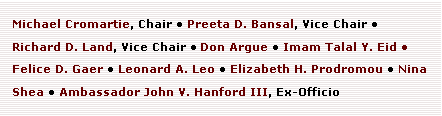
Michael Cromartie
Chair, U.S. Commission on International Religious Freedom
Nina Shea, Commissioner
U.S. Commission on International Religious Freedom
Imam Talal Eid, Commissioner
U.S. Commission on International Religious Freedom
David Hawk
Reagan-Fascell Fellow, National Endowment for Democracy
Peter Beck
Executive Director, U.S. Committee for Human Rights in North Korea
Jae Ku
Executive Director, U.S.-Korea Institute at the School for Advanced International Studies, Johns Hopkins University
The joint briefing will start at 2 p.m.
Apr 4, 2008
FOR IMMEDIATE RELEASE
April 4, 2008
Contact: Judith Ingram,
Communications Director,
(202) 523-3240
WASHINGTON-The United States Commission on International Religious Freedom urges President George W. Bush not to attend the opening ceremony of the Olympic Games in Beijing this summer unless there is substantial improvement in respecting Tibetans' religious freedom, including by opening direct and concrete talks with the Dalai Lama, the Tibetan Buddhists' spiritual leader. If the president does attend the opening, the Commission proposes that he first visit the Tibetan regional capital, Lhasa, or another Tibetan area, in an affirmation of the U.S. commitment to religious freedom for Tibetans, as well as for China's other growing religious communities.
The ongoing repression of legitimate Tibetan demands for greater freedoms has been a constant source of resentment. But it is the desire for greater religious freedom and related human rights that has been an important demand of recent protests: Monks at the Jokhang Temple affirmed to foreign reporters visiting Lhasa last week that repression of religious freedom lies at the heart of Tibetans' grievances. Religious freedom abuses in Tibet have long been some of the worst in China. Even before the current unrest, the State Department's 2007 Country Reports on Human Rights Practices indicated that religious repression has increased in Tibetan areas over the past year. The latest upheaval was sparked on March 10, when hundreds of monks from Drepung monastery demonstrated peacefully to end the government-imposed requirement of "patriotic education," which often requires monks to denounce the Dalai Lama, and to protest the continued detention of monks who celebrated the awarding of the Congressional Gold Medal to the Dalai Lama. Such peaceful protests are protected actions under international human rights standards, and they should not be met by force or detention.
"China's plans to ‘pacify' Tibet through religious repression alongside economic modernization and in-migration of mostly ethnic Han Chinese have fueled a deep and lasting resentment," said Commission Chair Michael Cromartie. "For too long, the Chinese have employed a ‘security' approach to Tibetan Buddhism-preferring repression, control of leadership decisions, castigation of the Dalai Lama, and ‘patriotic education' over freedom of thought, conscience, and religion. That approach is no longer viable; in fact, it is counterproductive. Fully guaranteeing freedom of religion is a necessary first condition for any negotiations regarding Tibet."
China could take immediate, confidence-building steps signaling its commitment to guaranteeing religious freedom for Tibetans by:
- lifting restrictions that are the source of resentment and protest;
- announcing an end to all "patriotic education" programs;
- repealing new laws requiring government approval of all lamas;
- affirming that minors should be able to engage in religious education at any age;
- ensuring safe passage for Tibetans traveling to Nepal or India;
- announcing that devotion to the Dalai Lama, including displaying and venerating his picture, is not a criminal act; and
- unconditionally releasing all detained monks and nuns.
The Commission strongly supports the longstanding United States' policy of calling on Chinese authorities to open a meaningful dialogue with the Dalai Lama to resolve the persistent dispute in Tibet, of which the recent clashes are only the latest confirmation. China should begin direct negotiations with the Dalai Lama with the aim of establishing true religious freedom and greater autonomy for Tibet inside China. "Religious freedom cannot be ensured without recognizing the authority of the Dalai Lama, his centrality to the beliefs of Tibetan Buddhists, and their steadfast loyalty to his leadership despite severe restrictions," Cromartie said.
The Commission also urges the U.S. government to call for restraint and an independent investigation into the unrest in Tibetan-inhabited areas of China, including reports of violence by both police as well as some civilian protesters. The Commission calls for the release of peaceful protesters from detention, a full accounting of all the individuals who have been killed, detained, or gone missing in the unrest, permission for international observers to gain unrestricted access to the TAR and other Tibetan-inhabited areas including permission to enter jails and prisons to monitor the treatment of detainees and investigate allegations of torture in custody, and immediate access by the injured to medical treatment. The Commission further calls on the U.S. government specifically to demand Chinese protection for the monks who spoke out at the Jokhang Temple last week. The Commission visited that temple during its August 2005 trip to China, which included meetings in Lhasa and at the Drepung monastery.
After a telephone conversation on Tibet between President Bush and President Hu Jintao last week, the White House reported that President Hu was open to restarting negotiations with the Dalai Lama. Yet Chinese media and officials continue to blame the Tibetan Buddhist spiritual leader and his so-called "clique" for organizing protests, endorsing violence, and trying to sabotage the Olympics. "Amid a campaign of public defamation and blame, we need to hear a clear statement from President Hu that promises restraint and an end to violence against peaceful protesters, as well as proposing plans for moving forward with concrete negotiations with the Dalai Lama. President Hu was previously Party Secretary of Tibet. More than any other Politburo member, he should grasp the need for a new approach," Cromartie said.
In order to counter any diplomatic efforts by the Chinese government to blame the Dalai Lama alone for recent unrest in Tibetan areas, the Commission urges the U.S. House of Representatives and the U.S. Senate to sponsor a joint resolution that objectively details the history of recent negotiations between the Dalai Lama and Beijing and makes a clear statement about the need for substantive discussions on Tibet that will lead to genuine freedom of religion and a level of autonomy consistent with Chinese law that allows ethnic minorities to be "master of their own affairs" while maintaining China's sovereignty. Such a resolution would garner the support of other governments as well, and enhance the common goal to see an end to violence and the start of substantive negotiations on the Tibetan crisis before the Olympics begin this summer.
The Commission's recommendations regarding the Olympics and Tibet also include the following:
-
If attending the Opening Ceremonies or any of the Olympic games in Beijing, President Bush should request to meet with prisoners and persons detained by the state because of their exercise or advocacy of freedom of religion and related human rights. President Bush should also attend an "unregistered" church to underline the Chinese government's violations of religious freedom through its efforts to control faith.
-
The U.S. government should seek unrestricted access to Tibetan regions to assess the situation and visit imprisoned monks.
-
In order to raise the profile of religious freedom and related human rights promotion through the 2008 Olympic Games in Beijing, the Commission has urged the U.S. Congress to
-
within funds appropriated for the security of U.S. citizens in Beijing during the 2008 Olympic Games, allocate sufficient resources to ensure that training and related information materials include content that:
- instructs security officials, Olympic spectators, and athletes regarding China's commitments to uphold for all visitors certain internationally recognized human rights standards during the Olympic Games; and
- informs U.S. citizens, participants, and spectators at the Olympic games of their rights protected under international law and identifies problem areas they may encounter with Chinese authorities, relating to the freedoms of expression, religion or belief, assembly, and association, including information on Chinese law and recent human rights practices of the Chinese government on these issues; and
- in order to promote a free and open environment, in concert with the principles of the International Olympic Committee (IOC) and the standards of the International Covenant on Civil and Political Rights, designate appropriate funding to independent human rights organizations to monitor and report on human rights conditions during the summer games to ensure that the Chinese government is in compliance with relevant commitments made to the IOC to uphold human rights and international standards during the Summer Olympics.
The Commission on International Religious Freedom, a bipartisan, independent federal body, is mandated by Congress to monitor abuse of freedom of religion or belief and related human rights around the world and to make recommendations to the President, State Department and Congress on ways to address religious freedom concerns.