
Feb 5, 2008
FOR IMMEDIATE RELEASE
November 13, 2001
Contact:
Lawrence J. Goodrich, Communications Director, (202) 523-3240, ext. 27
WASHINGTON - The U.S. Commission on International Religious Freedom, an independent government agency advising the Administration and Congress, has forwarded to President Bush a series of recommendations to promote religious freedom in Uzbekistan. The Commission found that the government of Uzbekistan, a key country in the war on terrorism, "substantially violates the religious freedom of its people." The text of the letter and recommendations follows:
November 9, 2001
Dear Mr. President:
The U.S. Commission On International Religious Freedom respectfully submits recommendations for policies to promote religious freedom in Uzbekistan as an integral part of heightened U.S. engagement with that country.
As discussed in our October 5 letter to you, the Commission supports the Administration's strong response to terrorism. That campaign against terrorism affords the United States a unique opportunity to encourage much-needed improvement by Uzbekistan's government in its abysmal treatment of religious exercise. In so doing we demonstrate our commitment to our principles and values, including the very rights and freedoms the terrorists would destroy.
Since 1999, under the guise of fighting terrorism, the Uzbek government has arrested, tortured, and imprisoned (with sentences up to 20 years) thousands of Muslims who reject the state's control over religious practice. In some cases, a Muslim's piety alone brings down state suspicion and arrest. Human rights organizations report that the majority of inmates were arrested on specious drug charges or only for having offending literature on their person. Once arrested, they frequently do not have access to a lawyer or are held incommunicado for weeks and sometimes even months. Though certain underground groups in Uzbekistan, including the Islamic Movement of Uzbekistan, pose a genuine security threat to the Uzbek government, virtually all observers (and many U.S. government officials) contend that the current government's extremely repressive policies are actively contributing to the growth of-and popular support for-radicalized groups there.
The Uzbek government continues to exercise excessive control over all religious practice in that country. Despite the constitutional guarantee of the separation of church and state, the Karimov government strictly regulates Islamic institutions, beliefs, and practice through the officially sanctioned Muslim Spiritual Board. The government claims the right to determine who can become an imam and the content of imams' sermons.
In addition, the Law on Freedom of Conscience and Religious Organizations passed in May 1998 severely restricts the right of independent Muslims, as well as minority religious groups, to exercise their religious freedom. Through a series of regulations that are often subjectively applied, the 1998 law imposes what the State Department's 2001 Report on International Religious Freedom calls "strict and burdensome criteria" for the registration of religious groups, criminalizes unregistered religious activity, bans the production and distribution of unofficial religious publications, and prohibits minors from participating in religious organizations. The State Department Report notes also that this law "restricts religious rights that are judged to be in conflict with national security, prohibits proselytizing, bans religious subjects in schools, prohibits private teaching of religious principles, and forbids the wearing of religious clothing in public by anyone other than clerics."
In short, the Commission finds that the government of Uzbekistan substantially violates the religious freedom of its people.
The U.S. Commission on International Religious Freedom, an independent federal agency, is mandated by the International Religious Freedom Act of 1998 to monitor violations of religious freedom abroad and to recommend to the Executive and Legislative branches U.S. policies to improve those conditions.
Pursuant to that mandate, the Commission respectfully recommends that the U.S. Government implement the policies toward Uzbekistan outlined in the attachment to this letter.
Thank you, Mr. President, for considering the Commission's findings and policy recommendations. We would be pleased to work with your staff and with the State Department to further explore their implementation.
Respectfully,
Michael K. Young
Chair
Recommendation 1. The U.S. government should continue to press forcefully its concern about religious freedom violations in Uzbekistan, consistent with the Uzbek government's obligations to promote respect for and observance of human rights. The U.S. government should also encourage scrutiny of these concerns in appropriate international fora such as the Organization on Security and Cooperation in Europe (OSCE) and other multilateral venues.
Recommendation 2. The U.S. government should press the Uzbek government to cease its abuse of those articles in its criminal code, including Articles 159 and 216, that negatively impinge on religious freedom.
Recommendation 3. The U.S. government should strongly encourage the Uzbek government to establish a mechanism to review the cases of persons detained under suspicion of or charged with religious, political, or security offenses and to release those who have been imprisoned solely because of their religious beliefs, practices, or choice of religious association, as well as any others who have been unjustly detained or sentenced.
Recommendation 4. The U.S. government should instruct the U.S. Embassy in Tashkent to continue to every extent possible its policy of carefully monitoring the status of individuals who are arrested for alleged religious, political, and security offenses.
Recommendation 5. While recognizing the Uzbek government's duty to protect its people from violence and terrorism from whatever source, the U.S. government should press the government of Uzbekistan to discontinue its practice of excessively regulating the free practice of religion in Uzbekistan, including the oppressive regulation of the Islamic clergy and the use of registration requirements to prevent minority religious groups from practicing their faith.
Recommendation 6. The U.S. government should press the Uzbek government to ensure that every religious prisoner has access to his or her family, human rights monitors, adequate medical care, and a lawyer, as specified in international human rights instruments, including Article 14 of the International Covenant on Civil and Political Rights. In addition, the U.S. government should press the Uzbek government to ensure that all prisoners are allowed to practice their religion while in detention, to the fullest extent compatible with the specific nature of their detention.
Recommendation 7. The U.S. government should press the Uzbek government to adhere to its international commitments to abide fully by the rule of law and to protect human rights ensuring due process of law to all.
Recommendation 8. All U.S. assistance to the Uzbek government, with the exception of assistance to improve humanitarian conditions and advance human rights, should be made contingent upon that government's taking a number of concrete steps to improve conditions for religious freedom for all individuals and religious groups in Uzbekistan. These steps should include:
-
releasing persons imprisoned solely because of their religious beliefs, practices, or choice of religious association;
-
ending torture;
-
halting the arrest and detention of persons because of their religious beliefs, practices, or choice of religious association; and
-
refraining from using registration requirements to prevent religious groups from practicing their faith.
The state should also relinquish at least some control over the Islamic clergy and believers.
In addition, U.S. security and other forms of assistance should be carefully scrutinized to ensure that these programs do not facilitate Uzbek government policies that result in religious freedom violations.
Recommendation 9. The U.S. government should continue to develop assistance programs for Uzbekistan designed to encourage the creation of institutions of civil society that protect human rights and promote religious freedom. This assistance could include training in human rights, the rule of law, and crime investigation for police and other law enforcement officials. Since such programs have been attempted in the past with little effect, they should be carefully structured to accomplish, and carefully monitored and conditioned upon fulfillment of, these specific goals.
Recommendation 10. The U.S. government should retain the recently reinstated Uzbek language program at the Voice of America (VOA), and should use VOA and other appropriate avenues of public diplomacy to explain to the people of Uzbekistan why religious freedom is an important element of U.S. foreign policy as well as specific concerns about religious freedom in their country. In addition, the U.S. government should continue its practice of encouraging exchanges between the people of Uzbekistan and the United States, paying attention to opportunities to include human rights advocates and religious figures in those programs.
The U.S. Commission on International Religious Freedom was created by the International Religious Freedom Act of 1998 to monitor the status of freedom of thought, conscience, and religion or belief abroad, as defined in the Universal Declaration of Human Rights and related international instruments, and to give independent policy recommendations to the President, the Secretary of State and the Congress." src-"/images/layout/subbottomtext1.gif" />
Michael K. Young,Chair
|
Feb 2, 2008
FOR IMMEDIATE RELEASE
Feb. 1, 2008
Contact: Judith Ingram, Communications Director
(202) 523-3240, ext. 127
WASHINGTON-Commissioner Felice D. Gaer will testify at a hearing of the U.S. Commission on Security and Cooperation in Europe (Helsinki Commission) at 2:30 p.m. on Thursday, February 7, on global efforts to monitor and combat anti-Semitism. Commissioner Gaer will focus on U.S. policies to fight anti-Semitism within the context of the 56-state Organization on Security and Cooperation in Europe, as well as the OSCE's own initiatives and performance.
Ms. Gaer is Director of the Jacob Blaustein Institute for the Advancement of Human Rights of the American Jewish Committee. Ms. Gaer, who was first appointed to the Commission in 2001, has served twice as Chair of the Commission, as well as Vice Chair. She has taken part in numerous meetings of the Organization for Security and Cooperation in Europe on behalf of the Commission, including the first-ever special meeting on anti-Semitism in 2003 and the 2004 Conference on Tolerance and the Fight Against Racism, Xenophobia, and Discrimination. Encyclopedia Judaica describes Ms. Gaer as having "played the key role in assuring passage by consensus of the UN General Assembly's first-ever condemnation of anti-Semitism" in 1998.
The other witnesses at the hearing include Dr. Gregg Rickman, Special Envoy to Monitor and Combat Anti-Semitism, U.S. Department of State; Rabbi Andrew Baker, Director of International Jewish Affairs, American Jewish Committee; Rabbi Marvin Hier, Dean and Founder, Simon Wiesenthal Center; Mark Levin, Executive Director, National Conference on Soviet Jewry; and Ms. Stacy Burdett, Associate Director, Government and National Affairs, Anti-Defamation League.
WHAT: Helsinki Commission Hearing on U.S., Civil Society Efforts to Combat Anti-Semitism
WHEN: Thursday, February 7, 2008, 2:30 p.m.
WHERE: 406 Dirksen Senate Office Building
Jan 25, 2008
FOR IMMEDIATE RELEASE
Jan. 25, 2008
Contact:
Judith Ingram, Communications Director,
(202) 523-3240, ext. 127
WASHINGTON-The United States Commission on International Religious Freedom has sent a letter to Secretary of State Condoleezza Rice urging U.S. action to intervene in the case of Sayed Parwez Kambakhsh, a 23 year old Afghan student and journalist sentenced to death for his alleged connection to the procurement and dissemination of writings that comment on Islam and women. "The Commission strongly urges the U.S. government to insist that the rule of law be respected by Afghan officials, in order to ensure that such severe human rights violations are not carried out in the name of so-called justice," Commission Chair Michael Cromartie wrote in the letter.
The Commission has previously pressed the need for U.S. officials to urge Afghanistan's government to protect freedom of expression against charges that may be used to stifle debate, such as blasphemy or apostasy. Particularly given the resurgent presence of the Taliban in Afghanistan, vigorous support for the right of every individual to freedom of thought, conscience, and religion or belief is necessary to ensure the full protection of fundamental human rights.
The text of the letter follows.
January 24, 2008
The Honorable Condoleezza Rice
Secretary of State
Department of State
2201 C St, NW
Washington, D.C. 20520
Dear Secretary Rice:
The United States Commission on International Religious Freedom requests urgent U.S. action to intervene with the government of Afghanistan in the case of Sayed Parwez Kambakhsh, a 23-year-old Afghan student and journalist who was sentenced to death on Tuesday for allegedly distributing literature deemed to violate the tenets of Islam. Mr. Kambakhsh's conviction and sentencing on a spurious allegation of blasphemy is a clear violation of Afghanistan's commitments under international human rights laws and an alarming signal of deteriorating conditions for the freedom of thought, conscience, and religion or belief and other human rights in the country. The rights to debate and to question the meaning or requirements of one's faith, as well as to dissent from state-imposed orthodoxy, are vital aspects of this fundamental freedom.
Mr. Kambakhsh was arrested in Mazar-e-Sharif in October 2007 in connection with an article that was downloaded from the Internet and sent to other students at his university. The article allegedly commented on Koranic verses about women. According to press reports, Mr. Kambakhsh was sentenced in a closed trial in which he had no lawyer to represent him, a clear violation of the internationally-guaranteed right to due process. Most significantly, his case was heard by the Shura-ye-Ulema, or Council of Religious Scholars, rather than by the country's media commission, as the law requires; only the media commission has the authority to determine whether the case should be heard before the courts. The Institute for War and Peace Reporting (IWPR), a non-governmental organization that promotes independent journalism, alleges that the case against Mr. Kambakhsh was motivated by some officials' desire to punish his brother, an IWPR contributor.
The Commission has previously voiced grave concern over the absence of adequate guarantees of freedom of religion and expression in the Afghan constitution, which can lead to unjust criminal accusations of apostasy and blasphemy. The Commission has called on the U.S. government to urge the government of Afghanistan to ensure the protection of all Afghan citizens from unfounded accusations of blasphemy, and to allow the peaceful discussion of the appropriate role of Islam in Afghan law and society. The U.S. government should also express serious concern over declining press freedom in Afghanistan, including increased official intimidation and harassment of journalists who are critical of the government.
Mr. Kambakhsh's case is sadly reminiscent of the 2006 threat of execution against Abdul Rahman, who had been sentenced to death for changing his religion, and the conviction of journalist and Islamic scholar Ali Mohaqiq Nasab in 2005 on charges of blasphemy and "insulting Islam" after he questioned discrimination against women and the use of amputation, public stoning, and other harsh punishments under traditional Islamic law. It is significant-and highly troublesome-that although both of those cases have been resolved, neither was settled in a manner demonstrating that human rights are adequately protected in Afghanistan; rather, Mr. Rahman was forced to flee the country and Mr. Nasab was required to issue an "apology" for his purported crime.
All three cases illustrate the increasingly problematic conditions for freedom of religion or belief in Afghanistan in recent years. These developments make clear that religious extremism-even in official circles-is an increasingly viable threat in Afghanistan, a threat heightened also by the return of the Taliban. The threat is exacerbated by the fact that the 2004 Afghan Constitution lacks clear protections for the right to freedom of religion or belief for individual Afghan citizens. The judicial system is empowered to enforce the so-called "repugnancy clause," which states that "no law can be contrary to the beliefs and provisions of the sacred religion of Islam." But interpretation of prevailing "beliefs and provisions of the sacred religion of Islam" is guided by particular views and jurisprudential schools within Islam, without regard to other strands of Islamic jurisprudence and without allowing room for debate and dissent within Islam.
Madame Secretary, the Commission has always believed that Afghanistan's unique circumstances present the United States with a special responsibility to act in the face of such travesties of justice as has occurred in the case of Mr. Kambakhsh. The U.S. government should therefore immediately contact President Hamid Karzai and other leading Afghan officials to communicate in the strongest possible terms that Mr. Kambakhsh must be freed immediately and the dubious case against him closed. It should reiterate that the United States vigorously supports respect for the right of every individual to freedom of thought, conscience, and religion or belief, and that the Afghan government must protect this and other constitutionally-guaranteed freedoms against charges that are clearly being used to stifle debate, including such as charges as blasphemy, "offending Islam," apostasy, or similar offenses. The Commission strongly urges the U.S. government to insist that the rule of law be respected by Afghan officials, in order to ensure that such severe human rights violations are not carried out in the name of so-called justice.
Sincerely,
Michael Cromartie
Chair
cc: The Honorable John D. Negroponte, Deputy Secretary of State
The Honorable Richard A. Boucher, Assistant Secretary of State for South and Central Asian Affairs
The Honorable John V. Hanford, III, Ambassador-at-Large for International Religious Freedom
The Honorable Stephen J. Hadley, National Security Advisor
The Honorable William Wood, U.S. Ambassador to Afghanistan
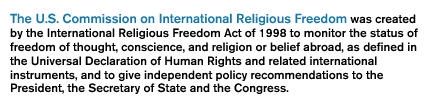
The U.S. Commission on International Religious Freedom was created by the International Religious Freedom Act of 1998 to monitor the status of freedom of thought, conscience, and religion or belief abroad, as defined in the Universal Declaration of Human Rights and related international instruments, and to give independent policy recommendations to the President, the Secretary of State and the Congress."
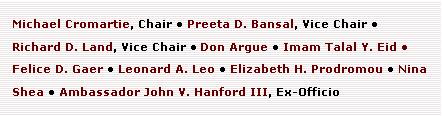
Michael Cromartie,Chair•Preeta D. Bansal,Vice Chair•Richard D. Land, Vice Chair•Don Argue•Imam Talal Y. Eid•Felice D. Gaer•Leonard A. Leo•Elizabeth H. Prodromou•Nina Shea•Ambassador John V. Hanford III,Ex-Officio