
Sep 23, 2020
FOR IMMEDIATE RELEASE
USCIRF Welcomes House Passage of Uyghur Forced Labor Prevention Act
Washington, DC – The United States Commission on International Religious Freedom (USCIRF) welcomed the House of Representatives’ passage yesterday of the Uyghur Forced Labor Prevention Act, which bars imports of all goods mined, produced, or manufactured in Xinjiang, unless proven by clear and convincing evidence that the goods were not produced using forced labor.
“We want to thank Representative Jim McGovern and Senator Marco Rubio for their leadership on this important legislation in Congress, as well as Speaker Nancy Pelosi’s strong floor statement and all the Members of the House who supported it,” USCIRF Commissioner Nury Turkel stated. “USCIRF urges the Senate to pass the companion bill swiftly and the President to sign it.”
Dozens of American and international companies are suspected of directly employing or sourcing from suppliers that use forced labor involving thousands of Uyghur and other Muslims. In March 2020, a bipartisan coalition of Members of Congress introduced the Uyghur Forced Labor Prevention Act (H.R.6210/S.3471). Currently, the Tariff Act of 1930 prohibits the importation of goods into the United States made wholly or in part by forced labor, but it requires U.S. Customs and Border Protection (CBP) to make specific determinations about individual firms and products. On September 14, CBP issued five new Withhold Release Orders (WRO) against cotton, electronics, and other goods produced by specific companies in Xinjiang. In July 2020, the U.S. government issued a business advisory on the risks of supply chains that rely on the forced labor in Xinjiang and elsewhere in China. The Department of Commerce also added 11 Chinese companies implicated in forced labor to the Entity List.
“It’s unconscionable that American businesses could still be importing goods made with forced labor of a religious minority,” noted USCIRF Commissioner Gary Bauer. “This bill would go along way in keeping such goods out of American markets, but corporate executives also need to do their part by either verifying beyond a reasonable doubt that their supply chains in China are free of forced labor or moving their business elsewhere.”
In its 2020 Annual Report, USCIRF called upon Congress to pass the Uyghur Forced Labor Prevention Act. In addition, it urged the administration to use its authority under the Global Magnitsky Human Rights Accountability Act and the International Religious Freedom Act to impose targeted sanctions on Chinese officials responsible for severe religious freedom violations against Uyghur Muslims, Tibetan Buddhists, Christians, and Falun Gong practitioners.
###
The U.S. Commission on International Religious Freedom (USCIRF) is an independent, bipartisan federal government entity established by the U.S. Congress to monitor, analyze, and report on threats to religious freedom abroad. USCIRF makes foreign policy recommendations to the President, the Secretary of State, and Congress intended to deter religious persecution and promote freedom of religion and belief. To interview a Commissioner, please contact USCIRF at [email protected].
Sep 22, 2020
USCIRF Urges Administration to Increase Refugee Resettlement Ceiling
Washington, DC – The United States Commission on International Religious Freedom (USCIRF) today reiterated its recommendation that the U.S. government commit to resettling 95,000 vulnerable refugees in the United States in Fiscal Year (FY) 2021, including survivors of religious persecution.
For each new fiscal year, which starts on October 1, presidential administrations determine a numerical ceiling for refugees accepted from abroad through the U.S. Refugee Admissions Program (USRAP).
“Unprecedented numbers of individuals worldwide are forcibly displaced by conflict or persecution, including based on their religion or belief, yet the resettlement to the United States of religious minority and other refugees has declined sharply in recent years,” said USCIRF Chair Gayle Manchin. “The United States must continue to offer safe haven to those targeted for their faith. A robust U.S. refugee resettlement program helps protect the most vulnerable victims of religious persecution. With FY 2021 fast approaching, it is imperative that religious persecution be considered in this determination, as required by the International Religious Freedom Act.”
Since the USRAP began in 1980, the ceiling for refugees accepted into the United States has averaged 95,000 per year, except in the past few years. It was 45,000 for FY 2018; 30,000 for FY 2019; and 18,000 for FY 2020, the lowest in the program’s history.
"USCIRF commends the Trump administration for its strong commitment to international religious freedom and increasing U.S. aid to displaced religious minorities," said USCIRF Vice Chair Tony Perkins. "Enabling refugees to safely and voluntarily return home should stay a top priority. However, resettlement to the United States through an appropriate process that ensures America's safety and security must continue to be available for those refugees who remain in life-threatening danger and unable to go back to their countries of origin, including religious minorities."
In its 2020 Annual Report, USCIRF recommended that the U.S. government return the annual ceiling for the USRAP to the previously-typical 95,000.
###
The U.S. Commission on International Religious Freedom (USCIRF) is an independent, bipartisan federal government entity established by the U.S. Congress to monitor, analyze, and report on threats to religious freedom abroad. USCIRF makes foreign policy recommendations to the President, the Secretary of State, and Congress intended to deter religious persecution and promote freedom of religion and belief. To interview a Commissioner, please contact USCIRF at [email protected] or Danielle Ashbahian at [email protected].
Sep 22, 2020
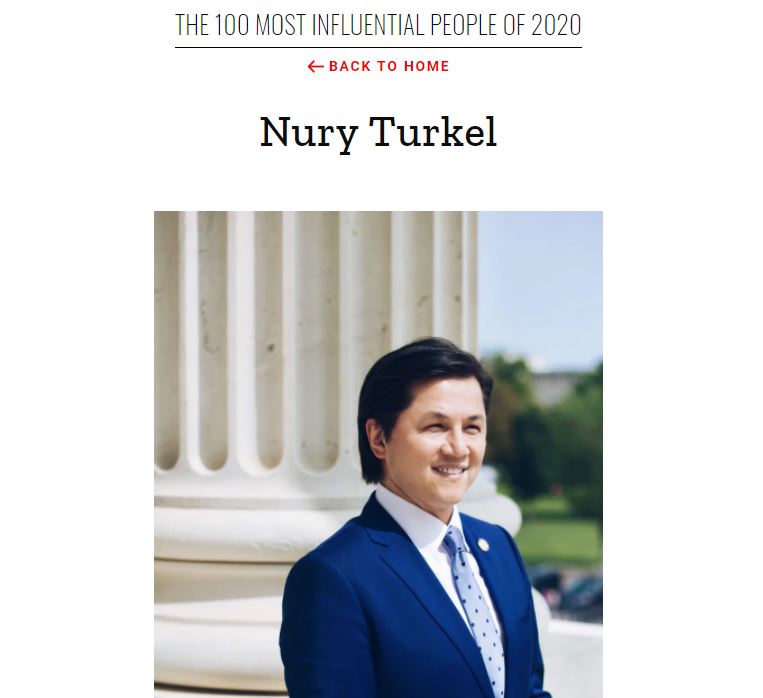
USCIRF Commissioner Nury Turkel Named to TIME’s Annual TIME100 List of 100 Most Influential People in the World
Washington, DC – The United States Commission on International Religious Freedom (USCIRF) congratulated Commissioner Nury Turkel who was named one of the 2020 TIME100, which is TIME magazine’s annual list of the 100 most influential people in the world. Commissioner Turkel was appointed to USCIRF in May 2020 by Speaker of the House of Representatives Nancy Pelosi.
“Nury Turkel, the first Uyghur-American Commissioner to serve at USCIRF, has been an exemplary colleague who fights diligently on behalf of minorities persecuted because of their beliefs,” said USCIRF Chair Gayle Manchin. “Commissioner Turkel has himself been subjected to hardships based on his religion as he was born in a re-education camp at the height of the Cultural Revolution in China and spent the first several months of his life in captivity. He has overcome so much and is very deserving of this recognition on TIME’s annual TIME100 List.”
As the first U.S.-educated Uyghur attorney, Commissioner Turkel has worked tirelessly over the years to give back to the community, building up the Uyghur human rights movement, assisting hundreds of people win asylum in the United States, addressing countless policy forums and legislative hearings, and bringing the plight of Uyghur people to the world’s attention, despite China’s best efforts to cover up its atrocities.
“The TIME100 List rightfully included Commissioner Nury Turkel for his insight and knowledge, especially given his experience and demonstrated commitment to advocating for religious freedom,” said USCIRF Vice Chair Tony Perkins. “His advocacy work has shed light on the plight of Uyghur Muslims in China and elsewhere, and has led to policy changes designed to counter the Communist Party’s genocidal actions against the Uyghur people.”
The TIME100 list, now in its 17th year, recognizes the activism, innovation and achievement of the world¹s most influential individuals. The full list and related tributes appear in the October 5, 2020 issue of TIME, accessible on September 25.
In its 2020 Annual Report, USCIRF called upon the U.S. government to use its authority under the Global Magnitsky Human Rights Accountability Act and the International Religious Freedom Act to impose targeted sanctions on Chinese officials responsible for severe religious freedom violations against Uyghur Muslims, Tibetan Buddhists, Christians, and Falun Gong practitioners.
###
The U.S. Commission on International Religious Freedom (USCIRF) is an independent, bipartisan federal government entity established by the U.S. Congress to monitor, analyze, and report on threats to religious freedom abroad. USCIRF makes foreign policy recommendations to the President, the Secretary of State, and Congress intended to deter religious persecution and promote freedom of religion and belief. To interview a Commissioner, please contact USCIRF at [email protected].