
Dec 21, 2015
FOR IMMEDIATE RELEASE
December 21, 2015
WASHINGTON, D.C. – The U.S. Commission on International Religious Freedom (USCIRF) today condemned the Sudanese government for charging 25 Muslims with apostasy and public disorder. Apostasy charges in Sudan carry the death penalty.
“The Sudanese government should drop all charges against these prisoners of conscience,” said USCIRF Chairman Dr. Robert P. George. “These charges contradict Sudan’s constitutional commitments to freedom of religion or belief, religious diversity and religious tolerance. The United States and other nations must continue to pressure the Sudanese government to release the 25 and uphold its international and constitutional commitments to religious freedom.”
A Khartoum criminal court charged the 25 with apostasy on December 10, subsequently releasing them on bail on December 14. The court proceedings will reconvene on February 9, 2016. Five of the defendants were arrested on November 2 in a Khartoum mosque after organizing a public event in which they discussed their Islamic faith; the others were arrested the next day. All were charged with apostasy because they interpret Islam differently than does the government: they view the Qur’an as the sole source of religious legitimacy and reject the Hadith. In 2011, 125 members of this same mosque were arrested for apostasy, but were released after recanting.
Article 126 of the Sudanese Criminal Code specifies that any Muslim who declares publicly that he/she adopts any religion other than Islam is guilty of apostasy, a crime punishable with death. In January, the Sudanese parliament amended article 126 so that those accused of apostasy who later recant can be imprisoned for up to five years and receive 40 lashings.
“These arrests and the increased penalties for apostasy highlight the fact that the Sudanese government continues to violate, on a systematic, ongoing and egregious basis, the religious freedom rights of its citizens. They also underscore the appropriateness of Sudan’s long-time designation as a country of particular concern and the continuing need for the U.S. government to increase efforts to encourage reform and discourage regressive behavior,” said Chairman George.
USCIRF in the 2015 Annual Report again recommended that Sudan be designated as a “country of particular concern,” or CPC, under the International Religious Freedom Act (IRFA) for its particularly severe violations of religious freedom. The State Department has designated Sudan as a CPC since 1999, most recently in July 2014. For more information, see the Sudan Chapter in USCIRF’s 2015 Annual Report.
To interview a USCIRF Commissioner, please contact USCIRF at [email protected] or 202-786-0615.
Dec 17, 2015
FOR IMMEDIATE RELEASE
December 17, 2015
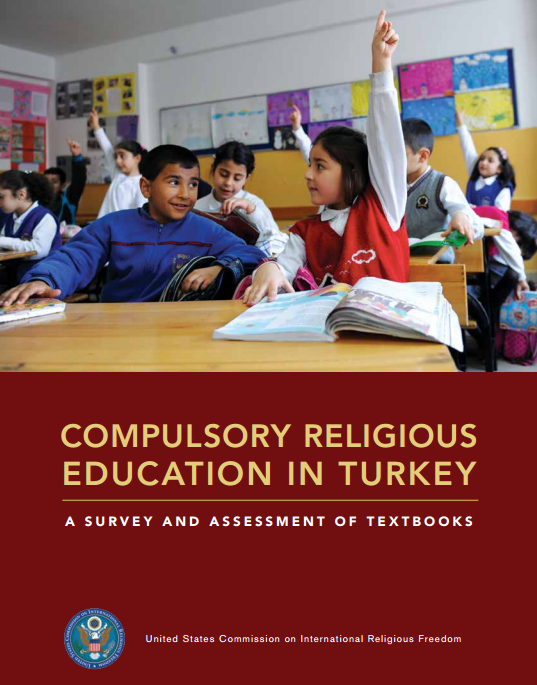 WASHINGTON, D.C – A new study of textbooks used in Turkey’s compulsory “Religious Culture and Moral Knowledge” class found both improvements and issues of concern. The U.S. Commission on International Religious Freedom (USCIRF) sponsored this study, which was conducted by Ziya Meral, a Turkish expert and 2010 USCIRF Crapa Fellow.
“The current Turkish textbooks are a clear improvement over earlier textbooks. They contain new sections on Alevi traditions and passages on the importance of religious freedom, and omit derogatory statements about non-Sunni Muslim religions. However, these textbooks also contain passages we fear could encourage intolerance toward, and reinforce negative stereotypes about, religious minorities and non-believers,” said USCIRF Chairman Robert P. George. “A country’s education system, including its textbooks, should promote religious tolerance. Such tolerance is critical to the social fabric of a country, and can provide a bulwark against extremist ideologies, sectarianism, discrimination, and stereotypes.”
This study, “Compulsory Religious Education in Turkey: A Survey and Assessment of Textbooks,” examined all nine textbooks used in Turkey’s compulsory “Religious Culture and Moral Knowledge” class. This class is taught to public school students from the fourth through 12th grades. The study found positive passages on religion and science, religion and rationality, good citizenship, religious freedom, and the origins of differences in Islamic thought. However, the study also found that the textbooks had superficial, limited, and misleading information about religions other than Islam, including Judaism, Christianity, Hinduism, and Buddhism, and linked atheism with the concept of Satanism.
The study made several recommendations, including that the Turkish government:
- Uphold the decision of the European Court of Human Rights and make religious education an elective for all children, Muslims and non-Muslims alike;
- In the meantime, ensure that all schools uphold the exemption option and school authorities support children who are exempted;
- Have experts from different religious faiths write sections about those religions; and
- Remove sections that negatively describe atheism and Christian missionaries or that reinforce anti-Semitic sentiments.
USCIRF long has monitored the status of the freedom of religion or belief in Turkey. Among other concerns, USCIRF received reports from religious minority communities that the textbooks required in the “Religious Culture and Moral Knowledge” class were problematic. USCIRF Commissioners discussed concerns about the textbooks with the Turkish Ministry of Education during a February 2014 trip. The Ministry acknowledged receiving similar reports, but noted that they had revised the textbooks in 2011. The Ministry shared the revised textbooks with USCIRF for its review and they were used for this study.
USCIRF placed Turkey on its Tier 2 list in its 2015 Annual Report. Tier 2 countries are those countries where the violations engaged in or tolerated by the government are serious and are characterized by at least one of the elements of the "systematic, ongoing, and egregious’ standard” of IRFA.
To interview a USCIRF Commissioner, please contact Travis Horne at [email protected] or 202-786-0615.
Dec 10, 2015
FOR YOUR INFORMATION
December 10, 2015 | Mary Ann Glendon and Katrina Lantos Swett
The following op-ed appeared in The National Interest on December 10, 2015
December 10 marks Human Rights Day, the sixty-seventh anniversary of the landmark Universal Declaration of Human Rights (UDHR). Unfortunately fundamental rights, including religious freedom, are still being violated worldwide.
Among the worst abusers are non-state actors like ISIL and other violent religious extremist groups. In Syria and Iraq, ISIL has persecuted Shia and Sunni Muslims alike, while reserving some of its worst depredations for Yazidis and Christians. From summary executions to forced conversions, rape to sexual enslavement, abducted children to destroyed houses of worship, attacks on these communities—among the oldest in the Middle East—are part of a systematic effort to erase their presence.
State actors from China to Iran to Uzbekistan continue their own assault on freedom: witness the persistent presence and gross mistreatment of prisoners of conscience.
In order to spotlight the plight of these prisoners, as well as the repressive laws and policies of the governments holding them, the Tom Lantos Human Rights Commission of the U.S. House of Representatives in conjunction with the U.S. Commission on International Religious Freedom (USCIRF), on which we serve, and Amnesty International USA, created the Defending Freedoms Project. Through this project, members of Congress select prisoners in order to call culpable governments to account and ultimately help free these prisoners.
Among these governments are those USCIRF has recommended to the State Department for designation as “countries of particular concern,” or CPCs, marking them as some of the world’s worst religious freedom abusers.
China, for example, imposed the draconian sentence of life imprisonment on Ilham Tohti in September 2014 for “separatism,” due to his peaceful activism on behalf of his fellow Uighur Muslims, whom the government persecutes relentlessly. Tohti was an economics professor in Beijing, where he was known for his research on Uighur-Han relations as well as his activism for the implementation of regional autonomy in Xinjiang.
Eritrea has been holding Orthodox Patriarch Abune Antonios since 2007 at an undisclosed location, preventing him from communicating with the outside world while reportedly denying him medical care. In 2006, Eritrea’s government had deposed him from his position as head of the Eritrean Orthodox Church and placed him under house arrest, ironically after he protested meddling in his church’s affairs. Among the accusations against the patriarch were his reluctance to excommunicate 3,000 members of an Orthodox Sunday School movement and his demands that the regime release imprisoned human rights activists accused of treason.
Uzbekistan holds up to 12,000 prisoners, mostly for the independent practice of Islam. In April 2010 it sentenced two sisters, Mehriniso and Zulkhumor Hamdamova, to prison terms of seven and six-and-half years, respectively, and their relative Shahlo Rakhmonova to a six-and-a-half-year term, for conducting private Muslim religious instruction of girls. Mehriniso was sentenced despite being a teacher for a government-approved women’s religion course, and is being held in deplorable conditions while battling cancer.
China, Eritrea and Uzbekistan exemplify nations in which secular authoritarian tyrannies refuse to accept the independence of religious communities, resulting in serious religious freedom violations against members of groups ranging from Catholics and Evangelicals, to Muslims and Jehovah’s Witnesses, to Tibetan Buddhists and Falun Gong.
Other nations, such as Iran and Saudi Arabia, have religiously authoritarian governments which enthrone a single religious group or interpretation while persecuting dissenting religious communities or individuals.
Iran sentenced Pastor Saeed Abedini in January 2012 to an eight-year prison term for participating in Iran’s house church movement. And for more than seven-and-a-half years, seven leaders of Iran’s Baha’i community have been imprisoned: Jamaloddin Khanjani, Afif Naeimi, Saeid Rezaie, Behrouz Tavakkoli, Vahid Tizfahm, Fariba Kamalabadi and Mahvash Sabet.
In Saudi Arabia, Raif Badawi, founder and editor of the Free Saudi Liberals Web site, was sentenced in 2013 to 600 lashes and seven years in prison, and ordered to shut down his site. After appealing his conviction for blasphemy and other charges, he was given a new sentence in 2014 of ten years in prison and 1,000 lashes. Badawi’s lawyer, Waleed Abu al-Khair—a human rights activist and the head of the group “Monitor of Human Rights in Saudi Arabia”—was given a fifteen-year sentence.
Unfortunately, tyrannies aren’t the only governments which perpetrate or tolerate severe religious freedom abuses. Pakistan, an electoral democracy, has more people on death row or serving life sentences for blasphemy than any other nation. Among them is Aasia Bibi, a Catholic mother sentenced to death in 2010 for blasphemy. In October 2014, her appeal was dismissed and her death sentence upheld. This summer, Pakistan’s Supreme Court accepted her appeal and suspended her death sentence. No hearing date has been set.
As we commemorate Human Rights Day, it is time for the world community to rededicate itself to religious freedom and other rights, hold abusers accountable and demand the release of these and other prisoners of conscience.
Mary Ann Glendon and Katrina Lantos Swett are Commissioners on the U.S. Commission on International Religious Freedom (USCIRF).
To interview a Commissioner, please contact USCIRF at [email protected] or 202-786-0615.