May 26, 2017
FOR IMMEDIATE RELEASE
May 26, 2017
IRAN: Release Maryam Naghash Zargaran
Commissioner Cliff May Says Religious Prisoners of Conscience “Should be honored for their contributions to society rather than penalized for…what they believe”
WASHINGTON, D.C. – The U.S. Commission on International Religious Freedom (USCIRF) strongly urges the Iranian government to release Maryam Naghash Zargaran from prison. Not only has she been detained unjustly because of her Christian faith, but the Iranian authorities have denied her urgently needed medical care. On this day last year, Maryam launched a hunger strike, sadly one of many, to protest the authorities’ disregard of her medical needs and refusal to grant her conditional release or medical leave.
“For more than four years, Maryam Naghash Zargaran has suffered in an Iranian prison, falsely charged with ‘propagating against the Islamic regime and collusion intended to harm national security’,” said USCIRF Commissioner Clifford D. May. “The Iranian government must cease its targeting of Christians and release Maryam and other religious prisoners of conscience. They should be honored for their contributions to society rather than penalized for who they are or what they believe.”
Commissioner Clifford D. May has taken up the case of Maryam Naghash Zargaran as part of USCIRF’s Religious Prisoners of Conscience Project. This project highlights the plight of individuals who have been imprisoned for their religious beliefs, practices, or identity.
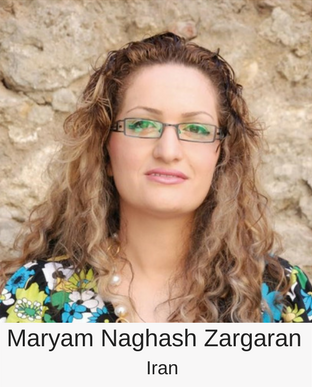
Ms. Zargaran was arrested in January 2013 and in July 2013 began serving a four-year prison sentence. Her sentence appeared to be in connection with her work at an orphanage alongside Iranian-American Christian pastor Saeed Abedini, who also had been unjustly imprisoned and was released in January 2016 after much international attention and protest.
Maryam suffers from several serious health issues, including heart disease for which she underwent surgery prior to her arrest and imprisonment. In September 2013, after an apparent heart attack, she reportedly was transferred from Evin Prison to Modares Hospital for treatment. Since then, she has undertaken multiple hunger strikes to protest her prison treatment, and has been granted several temporary medical leaves as a result. However, officials forced her to return to prison before her treatments were finished, causing her condition to worsen. In December 2016, Maryam was informed that her four-year sentence had been extended for 42 days because of the time she spent outside of the prison during the summer of 2016.
Since 1999, USCIRF has recommended, and the State Department has designated, Iran as a “country of particular concern” (CPC), for its “systematic, ongoing and egregious” violations of religious freedom. For more information, please see the chapter on Iran in USCIRF’s 2017 Annual Report. Read the chapter in Persian here.
The U.S. Commission on International Religious Freedom is an independent, bipartisan U.S. federal government commission, the first of its kind in the world, dedicated to defending the universal right to freedom of religion or belief abroad. To learn more about the Religious Prisoners of Conscience Project or to interview a Commissioner, please contact USCIRF at [email protected] or John D. Lawrence, Director of Communications ([email protected]/+1-202-786-0611).
May 26, 2017
FOR IMMEDIATE RELEASE
May 26, 2017
BURMA: Interfaith Prisoners of Conscience Pwint Phyu Latt & Zaw Zaw Latt Released
USCIRF Praises Their Release and Calls for All Prisoners of Conscience to be Freed
WASHINGTON, DC – The U.S. Commission on International Religious Freedom (USCIRF) expressed satisfaction that the government of Burma has released prisoners of conscience Pwint Phyu Latt and Zaw Zaw Latt. They were released along with more than 250 other prisoners Burma’s government freed as part of a presidential amnesty.
USCIRF Vice Chairman Daniel Mark, who has advocated on behalf of Pwint Phyu Latt and Zaw Zaw Latt, stated that he “welcomed this long-overdue step by Burma’s government. Pwint Phyu Latt and Zaw Zaw Latt, both Muslim, were wrongfully imprisoned for their interfaith activities. Although I welcome and applaud their release, the fact remains that they never should have been imprisoned in the first place. I hope their release signals a more positive trajectory for the freedom of religion or belief in Burma.”
Vice Chairman Mark took up the case of Zaw Zaw Latt and Pwint Phyu Latt as part of USCIRF’s Religious Prisoners of Conscience Project. This project highlights the plight of individuals who have been imprisoned for their religious beliefs, practices, or identity and the laws and practices that led to their imprisonment.
At an event in Washington, DC last week for the release of the USCIRF 2017 Annual Report, Vice Chairman Mark cited the case of these interfaith advocates as a dramatic example of a country using security laws to crack down on those pressing for religious freedom. He highlighted that the Immigration (Emergency Provisions) Act, one of the laws under which Zaw Zaw Latt and Pwint Phyu Latt had been detained and sentenced, had been repealed, yet they were not released and their sentences were not reduced. Their initial sentence was, in fact, extended in 2016 by two years of hard labor on the same day that more than 100 other prisoners were amnestied.
Vice Chairman Mark called on “the government of Burma to repeal repressive laws and policies that target individuals for peaceful dissent and expression and abide by international human rights standards and the rule of law.”
Although the 2017 USCIRF report noted a historic and peaceful transition of government in Burma in 2016, the Commission still recommended that the U.S. State Department designate Burma as a “Country of Particular Concern.” This recommendation is due to the government perpetrating or tolerating religious freedom violations that are “systematic, ongoing, and egregious,” with the most famous example being the abysmal treatment of the Rohingya Muslims in that country.
For more information, please see the chapter on Burma in USCIRF’s 2017 Annual Report. Read the chapter in Burmese as well.
The U.S. Commission on International Religious Freedom is an independent, bipartisan U.S. federal government commission, the first of its kind in the world. USCIRF reviews the facts and circumstances of religious freedom violations and makes policy recommendations to the President, the Secretary of State, and Congress. USCIRF Commissioners are appointed by the President and the Congressional leadership of both political parties. To interview a Commissioner, please contact USCIRF at [email protected] or John D. Lawrence, Director of Communications ([email protected]/+1-202-786-0611).
May 19, 2017
FOR IMMEDIATE RELEASE
May 19, 2017
RUSSIA: Release Bagir Kazikhanov
USCIRF Commissioner John Ruskay tells the Russian Government to
“Stop Equating Peaceful Religious Behavior with Terrorism”
WASHINGTON, D.C. – The U.S. Commission on International Religious Freedom (USCIRF) urges the government of Russia to release Bagir Kazikhanov, who was imprisoned unjustly because of his religious beliefs. May 21 marks the 10th anniversary of a Moscow district court designating as “extremist” 14 translations of the writings of Turkish Islamic theologian Said Nursi. Bagir’s so-called crime was being a reader of Nursi’s works.
“Bagir Kazikhanov has languished in prison since April 2014 simply for following the dictates of his conscience,” said USCIRF Commissioner John Ruskay. “It is long overdue for the Russian government to stop equating peaceful religious behavior with terrorism or extremism and immediately release Bagir Kazikhanov and other prisoners of conscience who have been imprisoned on false charges of extremism.”
Commissioner John Ruskay has taken up the case of Bagir Kazikhanov as part of USCIRF’s Religious Prisoners of Conscience Project. This project highlights the plight of individuals who have been imprisoned for their religious beliefs, practices, or identity.
Kazikhanov organized regular study sessions in rented apartments between 2012 and 2014 in Dagestan, a Russian republic, where he was born. During these study sessions, he and fellow Muslims studied the works of the highly regarded theologian Said Nursi. Kazikhanov was sentenced on February 25, 2015 to three and a half years’ imprisonment after being convicted under Part One of Art. 282.2 of the Russian Criminal Code for participating in “extremist activity.”
The Russian government continues to surveil, investigate, and prosecute Said Nursi readers for alleged extremism despite no apparent link to such activities. Another reader of Nursi’s writings was arrested in Russia a few weeks ago, bringing the number of Muslims known to be on trial or under criminal investigation for meeting to study Nursi's writings to twelve. On April 10, 2008, the Russian Supreme Court banned the “Nurdzhular” organization, an alleged conspiracy of Nursi followers which is widely believed to be a legal fiction the Russian government invented to facilitate the prosecution of Nursi adherents.
Due to these and other actions the Russian government has taken, USCIRF for the first time recommended in the 2017 Annual Report that Russia be designated as a “country of particular concern” (CPC) for its “systematic, ongoing, and egregious” violations of religious freedom. For more information, please see USCIRF’s 2017 Annual Report chapter on Russia. The Russian translation may be found here.
The U.S. Commission on International Religious Freedom is an independent, bipartisan U.S. federal government commission, the first of its kind in the world, dedicated to defending the universal right to freedom of religion or belief abroad. To learn more about the Religious Prisoners of Conscience Project or to interview a Commissioner, please contact USCIRF at [email protected] or John D. Lawrence, Director of Communications ([email protected]/+1-202-786-0611).